Sunday, September 16, 2012

Recumbent Ride -- B & O Trail


I took a break from the bike for a couple weeks while I was on my archery kick.  I like to mix things up to keep life interesting and to avoid burnout.  But now with days quickly getting shorter and the air crisp and clear I'm drawn back to the bike path like a salmon to the upriver spawning grounds. 

Earlier in the weekend I thought about doing the 50 mile Quarry Loop but after a late night around the campfire and one too many Strongbow Dry Ciders and Padron cigars I woke feeling less than 100%.   Knowing the fresh air would do me good I headed over to the B & O Trail in Richland County and busted out an easy 34 miles.


In the village of Bellville, Ohio I took a small detour off the trail and visited the band shell in the middle of the town. I love the way the afternoon sunshine lit up the stars and stripes.  I climbed a short but steep hill up out of the valley to find a place looking down onto the village but the view above was the best I could manage. I hit 40 miles an hour back down the hill. What a rush!


Back on the trail I past this place "Green Gene Acres". I remember a guy named Mr. Green Jeans and if you're as old as me you might remember him and the other guy he hung out with who was a Captain.

Pretty flowers along the trail

Old Mill, Lexington, Ohio


B & O Trail
Bike:  HP Velotechnik Street Machine
Ride Time:  2:19:57
Distance:  34.19 miles
Average Speed:  14.6 mph
Max Speed:  40.1 mph


Friday, September 14, 2012

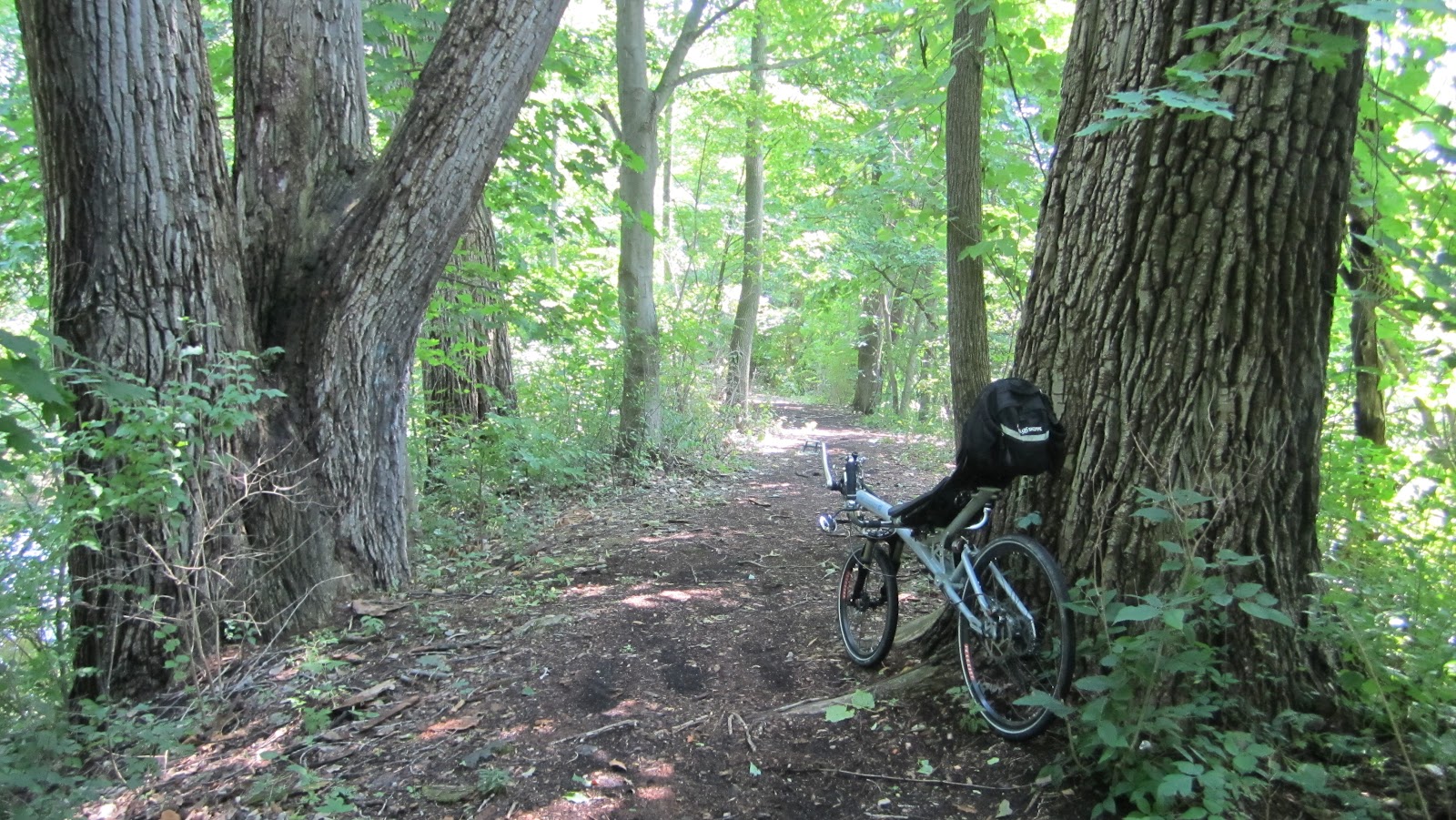
Non-Technical Dirt


These are some pictures I took earlier in the summer when I still had high volume tires on my recumbent bike.  While I really enjoyed the versatility fat tires offered I just couldn't stand the sluggish feel on the road or rail trail which is where I spend all my time on my laid back bike.  The location is a short loop in a local city park that I use as my testing ground for mountain bike adjustments and new component evaluations.  Less than a mile of singletrack but still a peaceful and cool place to get out from under a hot sun.


Sunday, September 9, 2012

Bow Tuning


I spent some time flinging arrows off the shelf instinctively with my Hoyt recurve while the string stretched out.  I had to unstring and add twists to the bowstring numerous times over the past week to keep the brace height at about 8 inches.  Since then the brace has stabilized I have moved on the next stage of the bow tuning process.  This weekend I installed a target bowsight, magnetic flipper rest and an adjustable plunger.
 
Other than a short period shooting an early 1990's round wheel compound bow I've spent the last 15 years shooting traditional recurves and primitive longbows exclusively without sights of any kind.  While this instinctive archery is cool and fun it requires nearly daily practice to really become an expert shot.  Because of all my other hobbies and not to mention a full time job I was not willing or able to devote the time necessary to become proficient as I would like.  This knowledge along with my desire to get away from heavy draw weight hunting bows is what led me the target archery.
 
It didn't take long at all for the accuracy potential of my new Hoyt recurve to make itself known just shooting barebow.  Once I had the bowsight installed and dialed in my groups went from gigantic foot and a half spreads to 6 inch groups at 20 yards (60 feet).  Up close say 5 to 10 yards I can hit a bottle cap size target regularly shooting instinctive but much past 12 yards things get sketchy fast.  It's been a long time since I used any type of sighting device and I have to say that it has done wonders for my confidence and group size to be using a pin sight again.


I've used flipper rests before but the riser mounted plunger is something completely new to me.  The plunger is the threaded rod with the black barrel shaped object protruding out from the lower right side of the riser in the opening picture.  I think the main purpose of the plunger is to move the shaft out away from the riser providing clearance for the feathers or vanes as the arrow leaves the bow.  The less contact the arrow has with the bow after release the better.
 
The plunger also provides for the fine tuning of the "launch platform" for the arrow and works in unison with the flipper rest.  The threaded rod is hollow to house the brass plunger tip and a spring to provide preload.  The plunger can be adjusted in or out to position the arrow shaft nose in or out relative to the string.  The barrel or body of the plunger can be screwed in or out to adjust the tension on the spring which acts as shock absorber to counteract flex of the arrow shaft as the transfer of energy from the bow limbs to the arrow occurs just after release.


I learned just how useful of a device the plunger can be in just two shooting sessions this weekend.  While shooting off the shelf with no rest or plunger I noted that my arrows stuck out of the target butt at a perfect 90 degree angle even though when at full draw the arrow pointed slightly right relative to the string.  The perfect square angle indicates that the arrows are of a correct spine or stiffness for the draw weight of the bow. 
 
When I installed the rest and plunger I initially set up the arrow to be pointing nearly straight ahead off the string.  After shooting a group of arrows I noted that all the nock ends were pointing slightly to the right. Consulting the Easton bow tuning guide online I learned to screw in the plunger to orient the tip of the arrow a bit left of center.  After this adjustment of only 1/16" to 3/32" off center the shot arrows were back to 90 degree penetration of the target.
 
The bow and arrow is a very simple device that's been around for thousands of years. The interesting part is how physics come into play and interact at the instant of release.  Add to that the marvel of modern technology and materials and the ability to tweak the equipment in such minute scale tuning the bow is almost as fun as watching the graceful arch of the arrow in flight.
 
Following are some pictures of groups I shot at 20 yards (18.288 meters)


Sunday, September 2, 2012

Target Archery


Wyatt will drop whatever it was he was doing if I mention going to the archery range.
 
LeeAnn came along to do the picture taking.  She did a great job! In the opening shot she released the shutter less than a second after Wyatt released the shot.
 

Wyatt has good form.


Arrow in flight.

 
I'm testing out some new archery tackle. A Hoyt Excel 23" riser and ZR330 30# limbs.  My arrows are 285 grain Easton A/C/C with 80 grain points.  Because the bowstring is new I'm just shooting bare bow off the shelf while the bowstring fibers stretch. It shoots like a dream! Once the brace height settles in I'll worry about an arrow rest and a permanent sight. 


Arrow in flight


Bullseye


Friday, August 24, 2012

Bicycle Commuting


I'm getting back into the swing of things after taking last week off and going on vacation with my family.  It's always tough heading back to work after some much needed R&R but the bicycle always seems to work its magic and makes it just a little bit easier.  I rode my bike to work four out of five days this week.  I drove the car once because I had some boxes and other stuff to transport. 

I've been kicking around the idea of buying a cargo trailer to expand my ability to portage bulkier items that just won't fit in my backpack.  The other day I had to make a quick run to the grocery store which is only about mile from my house.  I had to drive the car because I had to get a gallon jug of milk, orange juice and some other odds and ends.  Together it was too much stuff to carry on my back and a cargo trailer attached to my bike would have made it a piece of cake.  As far as the car is concerned from a mechanical standpoint I've talked to mechanics who say that an automobile needs to be run a minimum of eight miles just to bring the engine up to normal operating temperature.  Driving short trips and shutting the motor off allows harmful and corrosive compounds to build up in the engine that would otherwise be flushed out by a longer period of operation.

I like the idea of a trailer that I can disconnect from the bike and hang on the garage wall when I don't need it as opposed to a big heavy cargo type bike.  Earlier this week I got a Nashbar catalog in the mail and I noticed they had their cargo trailer on sale for just over a hundred bucks.  Think about it this way:  How long does it take to burn through a hundred dollars worth of gas.  The reasons to ride more and drive less just keep stacking up.


Tuesday, August 14, 2012

News from A.R.S. W8MDE


During the summer months my amateur radio activity usually slows or is even non-existent at times.  When it's warm outside that is where I like to be.  The lack of ham radio related posts on the blog bears this fact out.

After a few weeks away from my basement ham shack I do start to get the urge to transmit some signals into the ether.  The SKCC Week End Sprint is always scheduled for the second Sunday of the month and luckily I had no obligations so I had a blast working stations around the country with my wireless setup.  Using the very fine SKCC NT9K Pro-Pump long lever straight key I jumped right in feeling like I hadn't missed a beat.  As far as straight keys go the Pro-Pump is the sweetest key I've ever laid a hand on.  Even if I haven't touched it in weeks the code just rolls off with machine like precision.

The SKCC club key is based on a world famous Danish design called the Amplidan Model 50713 pictured below.  The Amplidan which has unfortunately been out of production for a decade or so was manufactured by the MP Pedersen Company of Denmark.


Photo courtesy of Morse Express


    You can sure see the family resemblance.  The Amplidan was a professional marine key and a favorite of ship's radio officers from countries all around the world.  These days Morse Code graces the airwaves from one source alone -the amateur radio service.  After using my long lever key for a couple years I can sure understand why this style of key was favored by those whose job depended on well sent code.

August SKCC Week  End Sprint Log - W8MDE

7.050MHz    W9DLN    Wisconsin
7.053    KG4PRK    Iowa
7.055    KC3QU    Alabama
7.115    AC2C    Maryland
7.055    WA5KMA    Texas
7.050    W0YZZ    Missouri
7.114    KE1AF    Rhode Island
7.113    W7GVE    Arizona
7.052    WA1HFF    Massachusetts
7.051    KA2FIR    New Jersey
14.057    W0INS    Florida
14.053    WN4AT    Alabama
14.051    K7TKT  Idaho
7.053    WA3SEE    Maryland
7.052    WB0PYF    Missouri
7.051    KJ4AOM    Kentucky
7.055    K4ZGB    Alabama
7.049    KK0I    Wisconsin
7.053    AA5VE    Texas
7.051    K4CNW    South Carolina

--

Other than the contacts listed above my last radio contact was nearly a month ago and a memorable contact it was.  One day I was simply turning the big tuning knob on my radio listening to various hams transmitting Morse Code on the 40 meter band when I stumbled across a station calling CQ.  (CQ means "calling any station, if you can hear me please respond!") I recognized the call sign N8ZYA which belongs to a ham and fellow blogger named John who lives in Charleston, West Virginia.  I quickly answered and we successfully conducted our first radio contact.  I was very pleased to finally meet John over the airwaves as we have been following each others blogs for a couple years now. 

Besides radio John and I share a few common interests like bikes and guitars.  John lives in a historic district and cannot erect an outside antenna on his property so he works strictly QRP (5 watts transmit power) and utilizes indoor antennas for his amateur radio activities.  Because Charleston sits in a valley surrounded by hills on all sides John often jokes that his radio signals are reflected and  amplified by the big gold dome of the State Capitol building not far from his house!  Read about his amazing accomplishments on his blog: http://n8zyaradioblog.blogspot.com/


Saturday, August 11, 2012

Recumbent Ride -- B & O Trail


Freelance Art on a Mansfield, Ohio bridge underpass

I spent a couple hours kicked back relaxing on my recumbent bike this afternoon.  While I was at it I managed to pedal the entire length of the B & O rail trail north and south logging 36 miles.  The air was moist from recent rains and the temperature only made it into the 60's so it was a great day to be out on the bike.  Trail users were few and far between because the sky was dark with heavy clouds and the occasional sprinkle.  Ideal conditions just the way I like it.


There is just a few places along the trail where Ohio shale is still visible.  The low hills were cut away providing a clear grade when the railroad was built in the 1850's.  After a 160 years the stoney berms are slowly crumbling.  I like these cool shady places.


I just happened to look down to my computer at about 29.5 miles and saw that I was going to hit 30 miles in just under two hours.  That spurred me on and I spun out the half mile reaching 30 with almost a couple minutes to spare.  I am loving the new Kojaks.  These tires are so much faster than the fat Primo Comets. I can't help but to put the hammer down and boy does it feel good.

Buckeyes - The Ohio State Tree


I saw these guys having an afternoon snack of tasty grass.  It's been so dry up until the last few days with a couple rain showers the grass is already starting to green back up.  I bet it tastes better green than the yellow dried up scrub these horses have been grazing all summer.


B & O Trail, Richland County
Bike:  HP Velotechnik Street Machine
Ride Time:  2:24:42
Distance:  36.7 miles
Average Speed:  15.1 mph
Max Speed:  22.8 mph


Friday, August 10, 2012

Shop Notes - Woodworking


I'm not a big garage saler but when I'm out riding my bike I always slow down a bit and give the yard sales I pass a quick scan for anything that might be valuable or useful.  On a recent road bike ride as I was heading through town I spotted this little bandsaw.  I pulled over to take a closer look and also noted a Dremel rotary tool with it's assortment of bits, burrs, sanding drums and cutoff wheels for ten dollars!  It was late Friday afternoon so I asked the women who were setting up the sale if they would be up and running the next day and if so I would return with the car to buy the two items.

The following day I drove the car over and bought the saw for $25 and the Dremel tool also. The sanding drums and cutoff wheels are worth the ten dollars by themselves so basically the rotary tool was free.  Normally I like to buy new tools to avoid the problem cases and other peoples worn out stuff but in this case I just couldn't pass up two hundred dollars worth of hardly used equipment for $35.

Besides some quick test cuts later that day to verify that the saw worked I haven't had a chance to do anything with it until now.  The extremely hot temperatures have finally eased off so I ventured out to my garage workshop to putter around.  I've wanted a band saw ever since I got into wood working many years ago but it was just one of those things I never got around to.  I have a similar saw at my business that I use occasionally or I made due using a handheld sabre saw.

The first official task for my new band saw was to prep some spindle blanks for lathe turning.  Before I used the Dremel and a cutoff wheel to cut grooves in the end of the stock.  I highlighted that process in a blog post here.

The end grooves in these spindles I cut free hand with the Dremel tool.
Cutting a precise X pattern in the end of a small stick of wood with a hand held rotary tool is tricky to say the least.  From the moment the cutter touches the wood extreme care has to be taken to keep the cutoff wheel on course and not flying off wildly from the torque of the rotating shaft.  The Dremel cutting discs are actually made of stone-like material so if you hog too much material or inadvertently tilt the tool too much once you've got a groove cut the thin wheel explodes with fragments flying everywhere.  There has got to be a better way and my new bandsaw provides it.

I thought about it for a bit and engineered a V-block that I could clamp down to the saw's bed and align squarely to the blade.  The V-block I made from a piece of hardwood birch plywood using two angled cuts on the table saw to create a V channel.  The plywood is expensive stuff imported from Scandinavia but it is very stable and is perfect for making jigs and fixtures. 


This view from behind the saw shows the dead-on alignment of the blank to the saw blade.  With my hands safely clear of the saw teeth just a slight push forward the blank slides in the V groove and into the blade.  I aligned the groove in the plywood slightly off center to the blade so I can make one cut then rotate the piece 180 degrees and cut again to end up with a wider slot in the end of the wood. 


The shot above shows the prepped blank chucked up in the wood lathe.  Notice how the flat of the spur drive closest to the camera lens lines up perfectly with the corner of the stock.  This precise alignment allows me to turn the square shape to round and end up with the largest diameter possible.  If my grooves or end holes are crooked or off center I would have to remove more material as I worked the stock down resulting in a smaller diameter spindle.

I have as much fun problem solving and engineering fixtures to facilitate my production processes as I do working on the actual project.  It must be the German in my blood.

Ready for the gouge!


Monday, July 30, 2012

Black Hand Gorge & Flint Ridge


On Sunday my wife planned to visit her cousin in Zanesville, Ohio and she suggested I bring my bicycle and go riding while they spent the day poolside.  (She comes up with good ideas!) After dropping off my family in South Zanesville I backtracked a few miles to the Black Hand Gorge State Nature Preserve to start my ride.  Black Hand Gorge has the distinction of being the only State Nature Preserve in Ohio that has a bike trail running through it.  While it is rather short at 4.25 miles in length the scenery along the way makes up for it.

Located in Eastern Licking County the east-west gorge was cut by the Licking River through Black Hand sandstone.  The sandstone formation is named after a hand shaped Indian petroglyph engraved on the face of a sandstone cliff along the north side of the river.  This petroglyph unfortunately was destroyed in 1828 when the cliff face was dynamited during construction of the Ohio & Erie Canal which passed through the gorge on it's way to the Ohio River.


Pictured above is the cliff and along the bottom several courses of sandstone blocks are visible. I'm guessing this was part of a canal lock.  Adjacent to the bike trail to the south is an abandoned quarry where these blocks likely originated.

It's too bad the Indian petroglyph no longer exists or hundreds if not thousands of years of human influence would be evident in this otherwise wild place.  The river valley probably offered safe haven and productive hunting grounds for countless primitive peoples.  In later times Ohio's first public works came through in the form of the canal system.  Soon to follow was the era of steam power as coal fired locomotives chugged and hissed up and down the gorge on a bed made flat by blasting away more sandstone as seen in the opening photo.  At least now we know to preserve these rare links to mankind's early ancestors.


After reaching the end of the bike trail I took to the county roads heading south to a place called Flint Ridge.  I decided to ride the Motobecane because as you can see in the photos there is no shortage of hills in South-East Ohio and nothing climbs like a titanium road bike.


My map does not differentiate between paved and gravel and of course since I was on the road bike with skinny tires I had to endure a few miles of this.  At least the road bed had been recently graded so I didn't have to put up with ruts and potholes.

The Flint Ridge State Memorial is located about six miles south from the Black Hand Gorge.  This place played a huge role in the lives of early Native Americans and is a interesting place to visit.
The following description I copied off signage placed by The Ohio Historical Society. It explains this unique geological feature and it's importance to the prehistoric people who inhabited the Ohio Valley:


Flint Ridge

Flint Ridge is a chain of long, narrow hills extending from a few miles east of Newark almost to Zanesville.  A distance of more than twenty miles.  The surface of these hills is underlaid with an irregular layer of flint, which may be only a few inches or several feet in thickness and varies greatly in color and texture.  In many places along this ridge the soil has been eroded revealing the underlying flint.  You are standing at one of these outcroppings. 

Flint is formed by a geologic process whereby the softer limestones and shales are replaced with much harder silica.  Due to its high quartz content, flint polishes beautifully and exceptional pieces of jewelry can be made from it.  The 106th General Assembly designated flint as Ohio's official gem stone in 1965 because of its occurrence in several parts of Ohio, particularly Flint Ridge, and because of its importance as a semi-precious gem stone.

Flint is both hard and brittle and thus can be broken into pieces that have razor sharp edges.  For this reason Indians as long as 9000 years ago traveled to this ridge to secure the rock for making projectile points, knives, and scrapers.  The area is now covered with hundreds of shallow pits from which flint has been quarried through the ages; several are visible along the trails.  The prehistoric Indians broke off chunks of flint with stone mauls or pried them out of the pits with wooden poles.  They broke the chunks into usable pieces with hammerstones, as shown here, and then proceeded to chip the flint for various purposes.

THE OHIO HISTORICAL SOCIETY - 1973

On the park grounds is a small museum which has the usual "Indian statues engaged in daily life" displays but also a very nice collection of Native American stone artifacts. This alone makes it worth checking out!  In the center of the building a large section of the floor is removed revealing an actual pit that has been cleaned out to show exactly the condition of the quarry with mining underway.


From the museum a foot path leads into the woods and within seconds smooth rounded bowl shaped depressions are visible all around.


I kept looking around and soon I found a flint deposit right at the edge of the hillside.


Black Hand Gorge - Flint Ridge Loop
Bike:  Motobecane
Ride Time:  1:56:46
Distance:  23 miles
Average Speed:  11.8 mph
Max Speed:  39.5 mph

Here is a link to more interesting reading on this unique subject:  Investigations at the Flint Ridge State Memorial, Ohio, 1987-1988 By Richard W. Yerkes, Ohio State University