Showing posts with label Ohio's Prehistoric Past. Show all posts

Monday, October 13, 2014

Dysart Woods


Eureka Timberland
 A useful tool I've found for exploring my home state is the Ohio Atlas & Gazetteer by Delorme.  I was looking at this book the other day and I noticed a place listed in the directory of Unique Nature Features called Dysart Woods.  I'm always interested in visiting unique places so I mentioned it to The RoadQueen. The main logistical problem we would have to accommodate is the roughly three hour drive to the location in southeast Ohio not far from Wheeling, West Virginia.

With such a long drive the outing was more than I wanted to deal with in a one day trip so The RoadQueen got busy with planning the route, Inventorying and staging the camping gear.  I decided to use the opportunity to field test a new tent I bought that is much smaller and lighter than my other tent.  My old dome tent was worn out and not doing much good at keeping out rain so it was time to for replacement.  

I've pictured the Cabela's Extreme Weather Tent in this blog that I use for extended trips and Field Day operations in amateur radio.  That is an awesome tent but at nearly 80 pounds it's not the most convenient for small car camping. In the future I plan on doing more solo bike adventures and also tagging along with The RoadQueen to some of her horseman's camps so I needed a good small weatherproof shelter that's easy to move and quick to set up.  

Instead of a new dome I settled on a more traditional A-frame style tent by Eureka called the Timberline Outfitter.  It's not a backpacker by any means at ten pounds but the tent does have a long and favorable reputation among the Boy Scouts of America.  If it holds up to the intense use of the Scouts I'm sure it will more than suffice for my occasional outings. 

We chose Barkcamp State Park as our base of operations which is only a few miles north of Dysart Woods.  We left Friday after I got home from work and arrived at the State Park at Dusk leaving just enough time to set up our camp.  The skies were overcast and it began to sprinkle as we assembled our gear and slowly shifted to a light rain as the evening progressed.  Nothing like a steady all night rain to test a new piece of gear and I'm happy to report the Timberline passed its trial by fire perfect.  We slept dry and comfortable on our cots and found the interior of the tent dry the next morning.     


The sun was out first thing and quickly dried up the surroundings from the previous night's showers.  I absolutely love camping in the state parks after the summer season comes to a close.  Park use drops significantly and we were one of only a handful of campers utilizing the place.  Also the changing leaves of autumn make it one of the best times of the year to spend some time outside.


Here's a piece of gear I've been using for a while now at my camp for brewing coffee in the morning. It is called a French Press and in my opinion makes the best cup o' joe out there.

After breakfast we left the state park and made a short trip along secondary routes and quiet country roads of Belmont County towards our objective Dysart Woods.  


I've found all parts of Ohio to be varied and beautiful but I always love returning to the hills of southeast Ohio.  Following the signs we shortly pulled up along this house that once belonged to the Dysart family who lived on this land for several generations.  What makes this place unique is that the family managed to keep a 50-acre tract of their land as untouched forest never allowing logging or other destructive land use to occur.  The result of this today is the largest known remnant of original old growth oak forest in southeastern Ohio.


Ohio University in cooperation with The Nature Conservancy has taken on the responsibility of maintaining and conserving this special natural resource.  OU uses the forest as a natural laboratory for researching and studying the dynamics of a mature oak ecosystem.  As an added benefit the public is encouraged to visit the park and walk its foot trails that wind among the forest giants some as old as 400 years.

Up the road a bit from the farmhouse we entered the woods and pulled into a marked parking area where we found a kiosk and a trail map to guide us along the two mile loop.


It was a chilly morning and the air was fresh and clean but soon the sun was warming things up and casting down its golden light into the forest.  We couldn't have asked for a better day for walk in the woods.

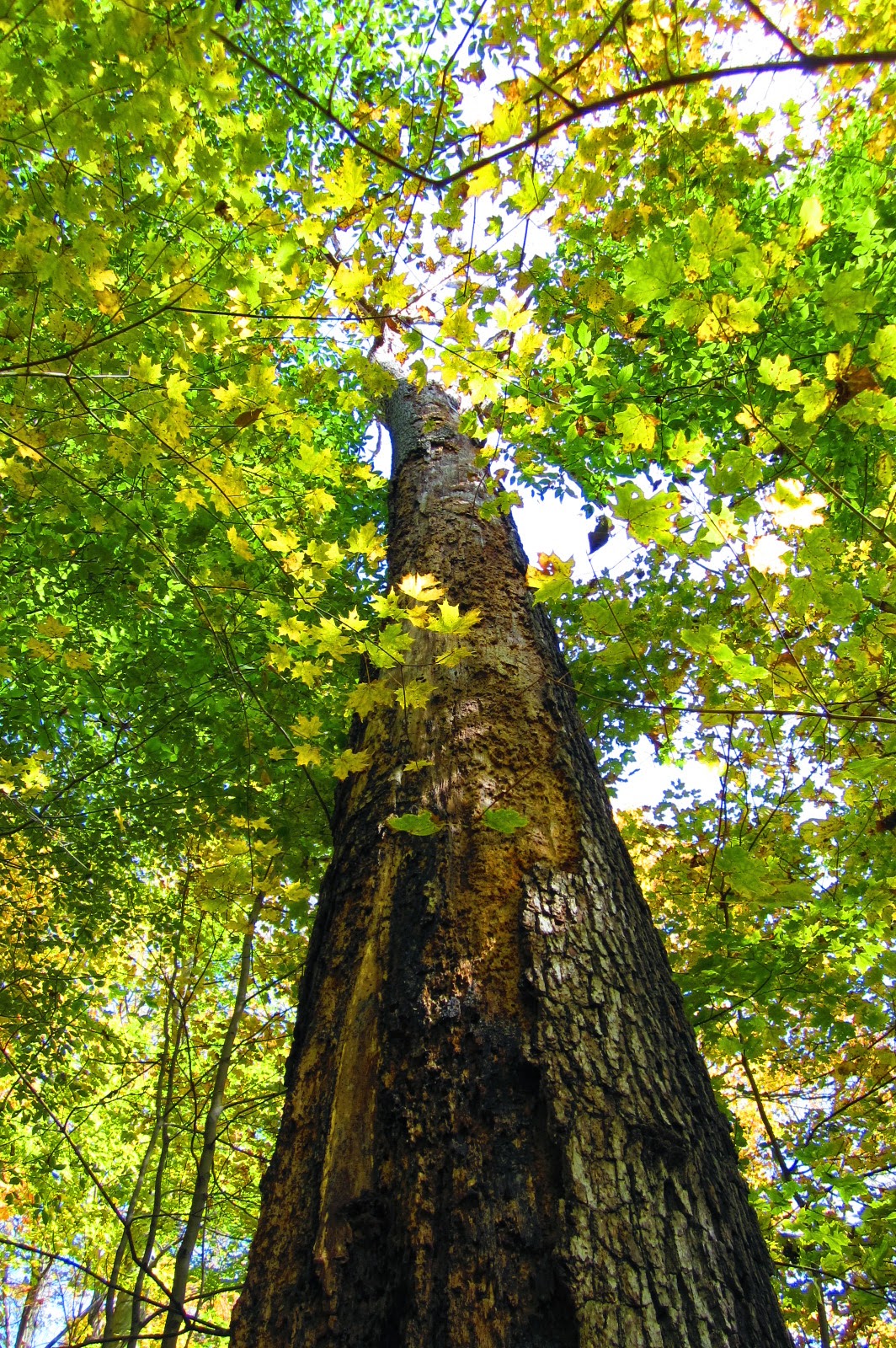
Just into the walk the surroundings looked like any other deciduous forest except for every so often when we came upon huge trees towering far above the trail.


Here's a white oak giant whose branches don't even start until well above the lesser trees of the understory.  I couldn't help but just stand there in awe of  this living thing that has existed since before the USA was even established. 


Size is not always an exact indicator of great age.  The mass of a tree can vary due to species and local conditions.  Here is me in the frame for scale. These are some massive trees.


The trail map we found at the trail head outlined some of the characteristics that indicate that a forest may be "Old-growth".  We were able to observe many of these criterion on our hike.  Here long ago a tree fell over and heaved up its root mass leaving a pit.  Slowly the root ball decayed and the soil remained in a mound.  This is called Pit and Mound Topography. 


Standing dead timber and downed logs are also definite clues of an old growth forest.  We saw lots of  dead trees standing easily a hundred feet into the air and many laying on the forest floor in various stages of decomposition.


The cycle of life and dependency of one kind of organism on the other was evident everywhere. To me it never gets old wandering around in the woods and witnessing with my own eyes the wonder of nature.


At one point the trail led us along an open hillside on the edge of the forest where we could look out to the surrounding hills.  It is hard to imagine that at one time most of the eastern U.S. was covered with endless forest.


Other trees we noted in the woods were plentiful maples and huge beech trees with their smooth gray bark. Cherry, black walnut, hickory and tulip trees also thrive in the area.


Above is another characteristic of an old growth tree.  Notice the at the base of the tree how the trunk widens out.  This is called the buttress.  A mature tree needs a sturdy base to remain in place.  Imagine the forces of wind during a storm that act upon a 140' tall tree.


I've not yet made it out west to see the great redwood forests but until then I think I can safely say these old boys are the oldest living things I've had the good fortune to meet in my short time on this Earth.

On the way back from Dysart Woods we toured a bit more of picturesque Belmont County. 


Arriving back at camp we got busy getting a fire going in preparation for a steak dinner and campfire potatoes cooked over an open hardwood fire.  We enjoyed the rest of the day relaxing and admiring the golden sunlight and colorful leaves around the campground. And later as night fell we stoked up our fire watched the stars come out and a three-quarter moon slowly raise up clearing the trees while a pack of coyotes yipped and howled in the distance.


Camping is a lot of work and it takes a bit of preparation to make it work smoothly but I wouldn't trade the experience for anything.  Spending a few days and nights outside of four walls and a roof cleanses the spirit and recharges the batteries like nothing I've ever found.


Sunday, September 29, 2013

Heritage Days Festival at Malabar Farm


 Whoo-Hoo Black Powder!

If I'm not burning some off myself second best is watching others do it!  Today Wyatt and I attended the Ohio Heritage Days Festival held annually at Malabar Farm State Park located in north central Ohio.  Malabar Farm is an interesting place to visit in and of itself being an actual working farm managed by the Ohio State Parks.  Once the home and passion of noted author, conservationist and World War One Veteran Louis Bromfield Malabar Farm comes alive once a year with the sights and sounds of history.


These reenactors are demonstrating colonial era firearms. The long gun would commonly rest on the mantle above the fireplace in a colonist's cabin and be called upon regularly to provide food and in times of war serve equally well.


Heritage Days does not concentrate on any one time period but encompasses all of Ohio's past.  Two civil war artillery units were set up firing off these big bruisers every couple hours through the weekend.  Sorry no pictures of the smoke because I had both my hands busy covering my ears.


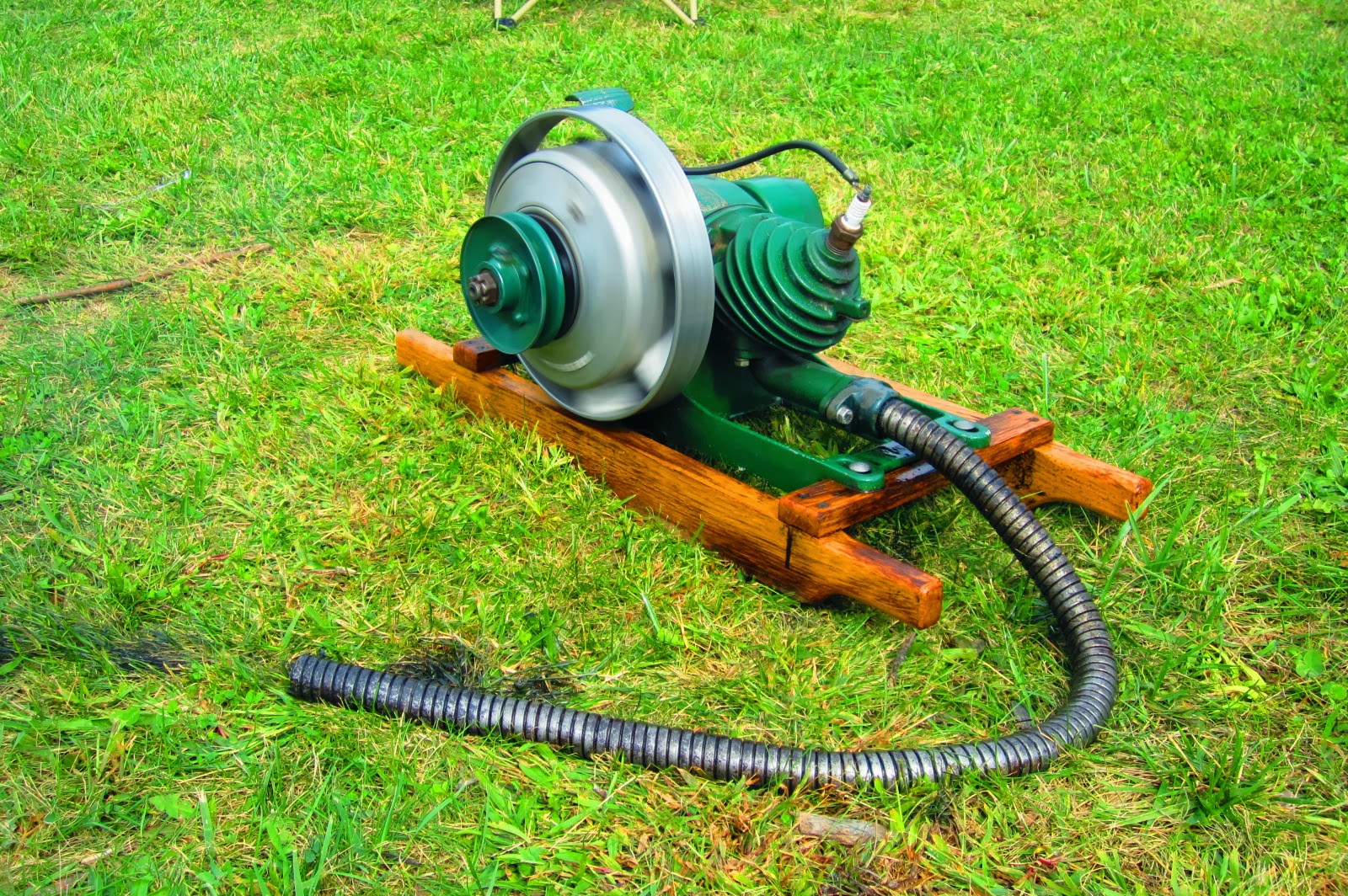
 I love old engines of all kinds.  On display was a couple engines from the early 1900's.  I would have loved to take some video of these old machines chugging away but I didn't have a video camera along.  About every 5 seconds the cylinder would fire keeping the flywheel spinning.  The metal hose sticking out and bent around the bottom of the photograph is the exhaust pipe.


This is an amazing engine built in Columbus, Ohio. I enjoy just standing beside these old relics and listening to the mechanical music of early single cylinder internal combustion.


As a tool guy and gadget man I found this display very interesting. What an incredible collection of vintage monkey wrenches dating back to the mid 1800's.


The tools that built a nation.


There was lots of other stuff going on around the farm that I didn't get photographs of.  Plenty of crafts and antiques were up for sale. The big house was open and the main barn was housing a large display of  ancient artifacts found in Ohio -arrowheads, spear points, axes and celts. Thousands of primitive weapons and tools from Ohio's prehistoric past.  Also in attendance was RoadQueen's Horseman's Club operating pony rides for the kids.

Although I've visited the farm on numerous occasions I've never been during the Heritage Days Festival. It was very cool and I look forward to checking it out again next year.

Monday, July 30, 2012

Black Hand Gorge & Flint Ridge


On Sunday my wife planned to visit her cousin in Zanesville, Ohio and she suggested I bring my bicycle and go riding while they spent the day poolside.  (She comes up with good ideas!) After dropping off my family in South Zanesville I backtracked a few miles to the Black Hand Gorge State Nature Preserve to start my ride.  Black Hand Gorge has the distinction of being the only State Nature Preserve in Ohio that has a bike trail running through it.  While it is rather short at 4.25 miles in length the scenery along the way makes up for it.

Located in Eastern Licking County the east-west gorge was cut by the Licking River through Black Hand sandstone.  The sandstone formation is named after a hand shaped Indian petroglyph engraved on the face of a sandstone cliff along the north side of the river.  This petroglyph unfortunately was destroyed in 1828 when the cliff face was dynamited during construction of the Ohio & Erie Canal which passed through the gorge on it's way to the Ohio River.


Pictured above is the cliff and along the bottom several courses of sandstone blocks are visible. I'm guessing this was part of a canal lock.  Adjacent to the bike trail to the south is an abandoned quarry where these blocks likely originated.

It's too bad the Indian petroglyph no longer exists or hundreds if not thousands of years of human influence would be evident in this otherwise wild place.  The river valley probably offered safe haven and productive hunting grounds for countless primitive peoples.  In later times Ohio's first public works came through in the form of the canal system.  Soon to follow was the era of steam power as coal fired locomotives chugged and hissed up and down the gorge on a bed made flat by blasting away more sandstone as seen in the opening photo.  At least now we know to preserve these rare links to mankind's early ancestors.


After reaching the end of the bike trail I took to the county roads heading south to a place called Flint Ridge.  I decided to ride the Motobecane because as you can see in the photos there is no shortage of hills in South-East Ohio and nothing climbs like a titanium road bike.


My map does not differentiate between paved and gravel and of course since I was on the road bike with skinny tires I had to endure a few miles of this.  At least the road bed had been recently graded so I didn't have to put up with ruts and potholes.

The Flint Ridge State Memorial is located about six miles south from the Black Hand Gorge.  This place played a huge role in the lives of early Native Americans and is a interesting place to visit.
The following description I copied off signage placed by The Ohio Historical Society. It explains this unique geological feature and it's importance to the prehistoric people who inhabited the Ohio Valley:


Flint Ridge

Flint Ridge is a chain of long, narrow hills extending from a few miles east of Newark almost to Zanesville.  A distance of more than twenty miles.  The surface of these hills is underlaid with an irregular layer of flint, which may be only a few inches or several feet in thickness and varies greatly in color and texture.  In many places along this ridge the soil has been eroded revealing the underlying flint.  You are standing at one of these outcroppings. 

Flint is formed by a geologic process whereby the softer limestones and shales are replaced with much harder silica.  Due to its high quartz content, flint polishes beautifully and exceptional pieces of jewelry can be made from it.  The 106th General Assembly designated flint as Ohio's official gem stone in 1965 because of its occurrence in several parts of Ohio, particularly Flint Ridge, and because of its importance as a semi-precious gem stone.

Flint is both hard and brittle and thus can be broken into pieces that have razor sharp edges.  For this reason Indians as long as 9000 years ago traveled to this ridge to secure the rock for making projectile points, knives, and scrapers.  The area is now covered with hundreds of shallow pits from which flint has been quarried through the ages; several are visible along the trails.  The prehistoric Indians broke off chunks of flint with stone mauls or pried them out of the pits with wooden poles.  They broke the chunks into usable pieces with hammerstones, as shown here, and then proceeded to chip the flint for various purposes.

THE OHIO HISTORICAL SOCIETY - 1973

On the park grounds is a small museum which has the usual "Indian statues engaged in daily life" displays but also a very nice collection of Native American stone artifacts. This alone makes it worth checking out!  In the center of the building a large section of the floor is removed revealing an actual pit that has been cleaned out to show exactly the condition of the quarry with mining underway.


From the museum a foot path leads into the woods and within seconds smooth rounded bowl shaped depressions are visible all around.


I kept looking around and soon I found a flint deposit right at the edge of the hillside.


Black Hand Gorge - Flint Ridge Loop
Bike:  Motobecane
Ride Time:  1:56:46
Distance:  23 miles
Average Speed:  11.8 mph
Max Speed:  39.5 mph

Here is a link to more interesting reading on this unique subject:  Investigations at the Flint Ridge State Memorial, Ohio, 1987-1988 By Richard W. Yerkes, Ohio State University