Sunday, July 3, 2011
Saturday, July 2, 2011
Local Loop
On busy holiday weekends I taper down my rides so I have some energy left for the festivities later in the day. The local loop provides the perfect mix of scenic views and distance for a short workout. While I was having coffee and watching the first stage of the Tour de France passing thunderstorms worked through the area. After a late breakfast of scrambled eggs and New Zealand kiwi fruits and more coffee the sun came out and dried things out.
I'm not sure what is happening here but the multi-colored spools of wire I had to photograph.
Local Loop
Bike: HP Velotechnik Street Machine
Distance: 20.01 miles
Ride Time: 1:27:48
Average Speed: 13.6 mph
Max Speed: 28.7 mph
Friday, July 1, 2011
K2H 13 Colonies Special Event
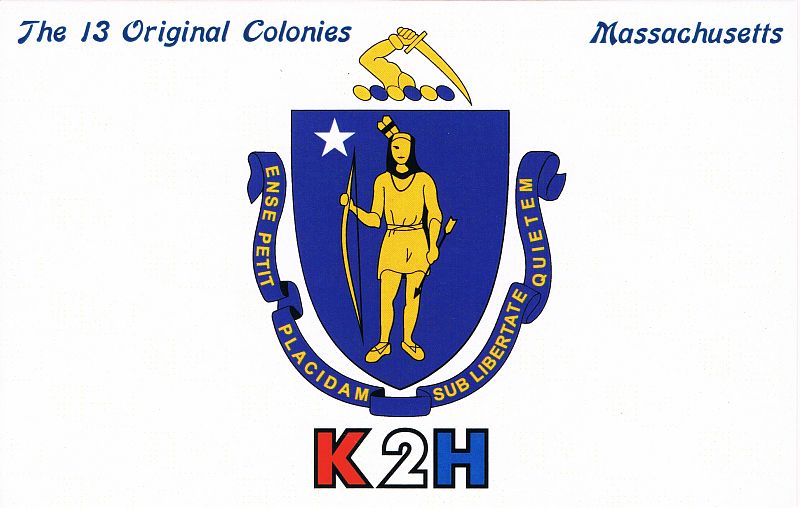
While I was having coffee this morning and listening to 40 meters CW I heard this station calling "CQ CQ de K2H 13 COL" at a comfortable 18 wpm. Usually short 1 x 1 call signs are assigned to special event stations. I worked the station and then looked up the call on qrz.com and confirmed that the station was indeed part of a 4th of July Special Event celebrating the independence of the original 13 colonies.
I like making contact with special event stations and enjoy collecting these one of a kind QSL cards.
more info at: http://www.13colonies.info/
Labels:
Amateur Radio,
QSL Cards,
Special Events
Thursday, June 30, 2011
W3AO Field Day
| Par End Fedz EF-40 at W8BAE |
The 25 is the number of individual operating positions working simultaneously under the club call sign. The A designates a portable operation. Most stations I worked during the Field Day event ranged between 1 and 8 participants under the same call.
Thanks to Jeff, KE9V at ke9v.net for posting a link to this club's Field Day page. I thought the call seemed vaguely familiar and certainly the "25 A" rang a bell. I checked my log and sure enough that was the station I worked.
Follow the link: W3AO Field Day Page to see a truly amazing display of logistics and good old ham radio enthusiasm.
Labels:
Amateur Radio,
ARRL Field Day
Monday, June 27, 2011
ARRL Field Day 2011
This year's Field Day activities were some of the most fun I have had yet as an amateur radio operator. Because of scheduling conflicts the site we used last year was unavailable so we had to scramble to find a place to set up. In the end the club did find a great location on private property bordered by highway US 30 on one side and a CSX railroad line on the other.
The place looked like an average campground with the exception of each campsite having it's own working amateur radio station. There was no electrical service on the property so we used a combination of generator and battery power for our operations. Using the club callsign W8BAE (That's "Whiskey-8-Bacon-And-Eggs" for you phone guys) we covered 40 meters CW and SSB (single side band voice) , 20 meters PSK-31 and SSB, 15 meters SSB, 6 meters SSB and 2 meters SSB for VHF. We even had a YL (female operator) gracing the airwaves with her voice on 15 meters.
Here is the 40 meter phone station of Roger WM8I and Wayne KB8ATE. I love watching these two experienced hams at Field Day. Besides making lots of contacts these guys are always swapping out equipment and trying different antennas. This year they deployed a quarter wavelength vertical with a full compliment of ground radials.
I set up on the other corner of the pond where I had access to trees along the CSX right of way to hang my new Par End Fedz EF-40. I have no picture of this antenna because it is basically a 65 foot long piece of black wire that all but disappears when viewed against a background of foliage. The heavy duty tripod is visible that I used to suspend the feed point/impedance matching box about 8 feet above the ground. The wire then sloped up to a tree top 40 feet above the feed point.
A peek inside my spartan station. I love the warm glow of a kerosene railroad lantern and with a LED light clipped to the bill of my hat I was able to work stations well into the wee hours. When I finally heard one too many beeps of Morse code I got out my bed roll and caught a couple hours of shut eye with my head under the table. Croaking bullfrogs and the rumble of passing freight trains definitely added a unique ambiance to the experience.
By late Sunday morning I had logged 102 contacts with various stations in 30 different states and 2 Canadian provinces. This is my new benchmark being the most stations I have ever contacted in a single operating event. A cool bonus from the Field Day rules states that cw contacts count as two points while phone contacts are worth one point. My efforts proved a great contribution to the club's overall score and I got a huge workout copying fast code on a busy band. Our main objective(s) was to have a great time, eat lots of good food and play radio. I'm confident we succeeded on all fronts.
Labels:
Amateur Radio,
ARRL Field Day
Thursday, June 23, 2011
SKCC K3Y 2011 -- Special Event
These images are scans of two QSL cards I received this week confirming contacts I made participating in the SKCC's 5th anniversary special event. Each January club members from the various U.S. call sign districts (see map below) can volunteer to operate under a special club call sign issued specifically for the month long event. The object of the K3Y event is to work one unique station from each of the ten call sign districts.
Below are the back sides of the two cards listing the contacts I made and a brief history of the club. I missed a full sweep of all call sign districts by one QSO. Had I netted a contact with a California or Alaska K3Y station I could have received a certificate for my accomplishment. I remember hearing a K3Y/6 calling from California and tried to reach him but evidently my signal was not reaching his antenna. I'll look to nail it down next January and maybe consider even applying to operate as a special event station myself.
The design for the front of the QSL card is chosen by vote from examples submitted by club members. This year's card featuring an old school drafting style drawing of the NT9K club key is my favorite and was the design I voted for. My NT9K Pro Pump is the key I rendered in black and white and use as the header photo for many of my amateur radio posts.
(Map attributed to Chris Ruvolo, Wikimedia Commons)
Labels:
Amateur Radio,
QSL Cards,
Special Events
Wednesday, June 22, 2011
Road Bike Ride
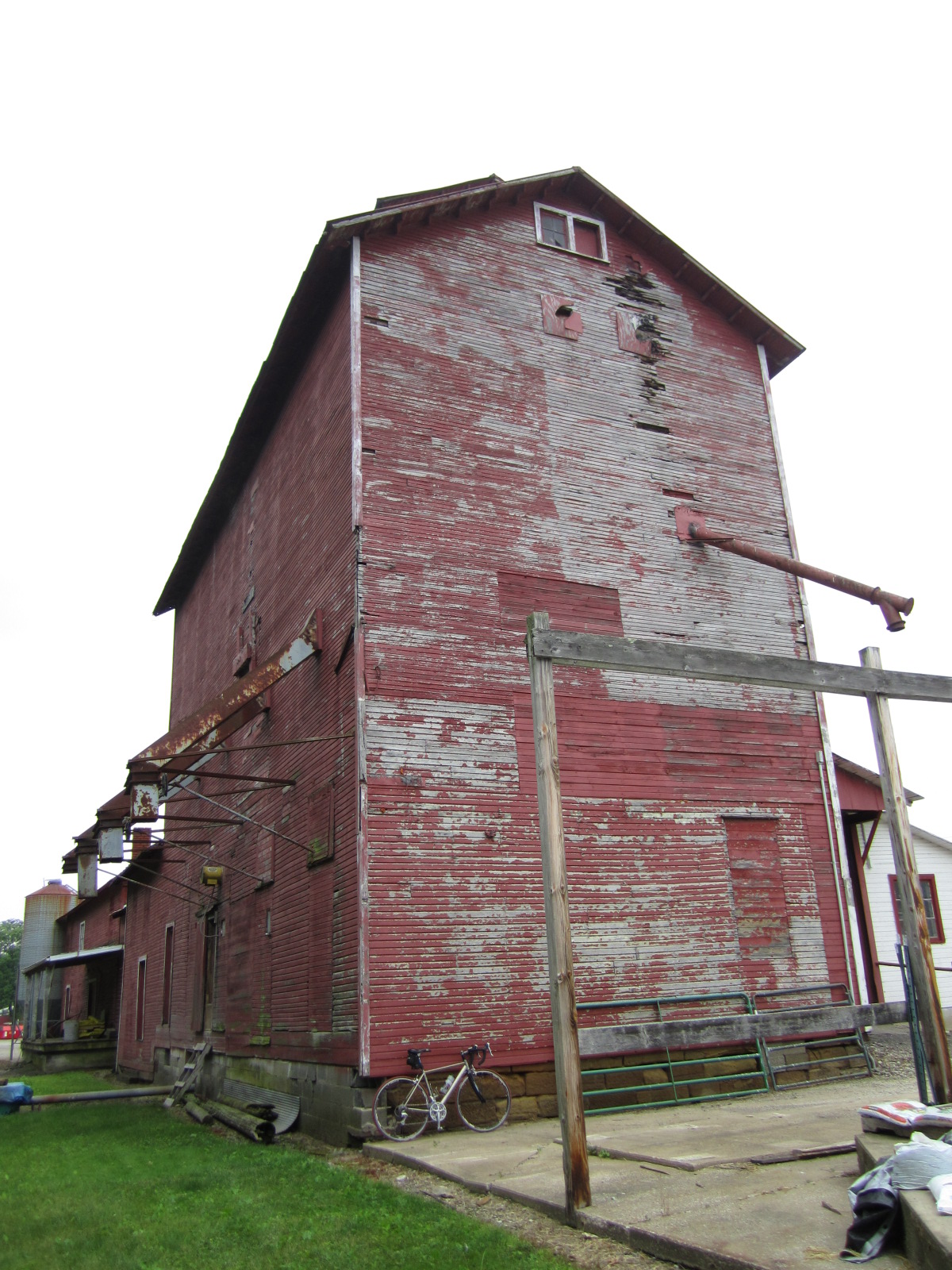
Grain Elevator at Bellville, Ohio
On the last day of my extended weekend I decided to go for a midday ride on the B & O Trail. I always enjoy putting in a good effort aboard the road bike especially a day or two after a long recumbent ride. The section of trail I rode connects the small towns of Lexington, Bellville and Butler Ohio. In order to reach my half way point at 12.5 miles I had to extend my ride a mile past the end of the bike trail. The road I chose was mostly an uphill climb out of the village of Butler. I estimate a couple hundred feet of elevation maybe a bit more. Once turned around I rocketed back down the hill and set a new top speed record on my road bike.
B & O Trail -- Lexington to Butler
Bike: Motobecane
Ride Time: 1:39:07
Distance: 25 miles
Average Speed: 15.1 mph
Max Speed: 44.4 mph
Motobecane Odometer: 212 miles
Father's Day Weekend
I spent Father's Day Weekend with my Dad at his place on the top edge of Ohio. The Lake Erie shoreline is an interesting place no matter what the season or weather conditions.
An afternoon thunderstorm drifts across the lake.
Saturday, June 18, 2011
Ohio & Erie Canal Towpath Trail
The Cuyahoga River Valley winding it's way approximately 40 miles between Cleveland and Akron Ohio is great place to enjoy nature and soak in some history from Ohio's early statehood. The key historical feature of this area is the evidence of 44 locks that were used to raise and lower canal boats the 395 feet in elevation between Cleveland and Akron.
The Northern end of the Ohio & Erie Canal was completed in 1827. The final 300 mile stretch south to the Ohio River at Portsmouth was reached in the the 1830's. The canal was the young state's first infrastructure and was the key catalyst to Ohio's early economic and industrial growth. The opening of the canal also provided the final link in a waterway leading from the Great Lakes all the way to the Gulf of Mexico.
The Parks Service maintains a twenty mile stretch of the canal way and surrounding natural areas known as the Cuyahoga Valley National Park. The unique feature is the crushed limestone towpath that visitors can hike or bike. This is the very same path that was used by draft animals to tow the canal boats laden with goods to and from market.
I knew I was in for a long day on the bike so I rode the recumbent. The crushed stone surface while relatively smooth was marked with occasional bumps and erosion irregularities so the full suspension of my bike was welcomed. However I did spot all types of bikes on the trail from road to mountain and even a recumbent trike rider I encountered near Cleveland.
On average the locks would raise the boats about nine feet although one lock appropriately named deep lock elevated a whopping 17 feet. In many of my photographs the lock structure appears to be cement. The concrete was added in the early 1900's and covers the original building blocks hand hewn from local sandstone quarries.
For most of the canal way the towpath is nothing more than a strip of high ground between the canal and the Cuyahoga River. The Cuyahoga was the water supply for the canal and a clever system of feeders and water control gates were utilized to fill and drain sections for repairs.
Water Control Gate
The Cuyahoga river twists and turns like a serpent and at lock 29 the canal and the river crossed paths. In the picture below is a bridge with arched sides. This bridge crosses the Cuyahoga where it is constricted to a narrow channel constructed from the same blocks used to build the locks. An aqua duct constructed of wood and steel carried the canal boats over the river.
View looking down into the river channel from the bridge. This would be the same view that passengers on board the canal boats would have seen as they passed over the aqua duct.
In the visitors center I found an excellent replica of the stern section of a typical canal boat and some great old photos depicting life on the canal.
The canal was owned and maintained by the state but the boats were operated by private captains who lived with their families aboard the boats.
As lost in time and nature as I felt riding along the green pathway in the valley large spans overhead remind that progress marches on.
Many sections of the canal look like this with nature slowly reclaiming the man made channel once 40 feet wide by 4 feet deep. Other parts are completely overgrown with nothing more than a dry linear depression through the woods.
This trip was a great way to spend a Friday afternoon and it did not feel like 5 hours on the bike at all. I really felt great and wished to ride more but it was nearing six o'clock and I still had an hour drive in the car to get home. The Cuyahoga Valley is a magical place full of natural beauty and history nestled right in the middle of Ohio's oldest and largest industrial complex.
Friday Ride -- Ohio & Erie Towpath Trail
Bike: HP Velotechnik Street Machine
Ride Time: 4:59:34
Distance: 62.04 Miles
Average Speed: 12.4 mph
Max Speed: 27.1 mph
Thursday, June 16, 2011
Power Supply Test at KD8JHJ
To facilitate portable operations with my Icom 718 high frequency transceiver I needed an alternative to the heavy and bulky traditional power supply used in my basement ham shack. The latest addition to my station equipment is the Astron Model SS-25M switching power supply. The rated output is 13.8 VDC @ 20 amps continuous duty.
Traditional non-switching power supplies use big transformer coils to produce very linear and "clean" power. Because of the circuitry involved some switching power supplies can generate unintentional radiation that manifests itself in the form of hash or static that can be heard on high frequency receivers. Obviously no good if you are trying to use that particular piece of radio spectrum for communications. After the initial voltage check I found that the Icom's receiver was just as quiet as when powered by my other supply which not incidentally is an Astron RS-35M.
The terminal blocks on the back of the SS-25M have pin holes with set screws. When I made pins from a couple brass machine screws I left them a bit long intentionally so a few threads remained exposed past the tops of the thumbscrews. The screw tips make a good place for my test leads to hook up.
The SS-25M does have a fan for cooling mounted on the back of the chassis. With my transceiver set at 50 watts of power the fan would start after 5 minutes or so of 20 word per minute cw (Morse code) transmission on 40 meters. It would shut off after a minute or two or quicker if I stopped transmitting. I'm sure the fan's cycle would change proportionately to the load placed upon the supply. While noticeable I did not find the fan's sound objectionable even operating without headphones using the radio's speaker.
The big advantage to this power supply is the light 4 pound weight and compact dimensions. Another feature I don't mind paying a little extra for is the separate volt and amp meters for monitoring output voltage and current. Electricity is invisible and dangerous and I like gadgets that tell me it's where it's supposed to be.
More on switching power supplies: http://en.wikipedia.org/wiki/Switched-mode_power_supply
Monday, June 13, 2011
SKCC Week End Sprint
Last month I missed the Straight Key Century Club's Week End Sprint for some reason. This weekend I made it a point to power up the station and get some contacts in the log. What I really enjoy is the laid back and casual style of this CW sprint. There are slow straight key brass pounders and speedy semi-automatic bug operators so it is easy to find contacts whatever your skill level. Since I have the NT9K straight key (pictured above) and a Vibroplex bug both connected I will jump back and forth and use which ever key I hear the other op using. In my opinion there is no sweeter music than that of a well executed bug to bug exchange.
I did no CQ calling or runs this time around but just wandered about handing out my number and saying hello to other club members around the country. I even found my friend Bill, KB2RAW transmitting CQs up on 15 meters (21 MHz). His signals were booming in loud and clear from New York State. Increased solar radiation from the sun has the ionosphere charged up allowing for propagation on the higher frequencies. A savvy contester knows to take advantage and check all the bands for activity.
June 12, 2011 SKCC Week End Sprint Log
A.R.S. KD8JHJ
14.053 N4SR Tennessee
7.108 WI0S Minnesota
7.114 K4NP Tennessee
7.115 NW2K New York
7.055 WA3SLN Pennsylvania
7.054 W4FOA Georgia
7.050 WD9DWE Indiana
7.049 KA2FIR New Jersey
7.052 W1LVT Vermont
7.052 W3NP West Virginia
7.054 KJ4LEN Florida
14.055 KD2JC New Jersey
14.050 W5ZR Louisiana
14.054 W7GVE Arizona
14.057 N3MVX Pennsylvania
21.053 KB2RAW New York
14.054 WD0ECO Missouri
7.052 K2NPN New York
7.056 N4SR Tennessee *
7.050 W5ZR Louisiana *
7.054 K2OGT New York
7.059 W1WIU Rhode Island
7.052 KG4W Virginia
7.112 WA0BGV Missouri
* Denotes 2nd band contact. During the sprint if the same station is contacted on another band that contact may be counted as an additional QSO (radio contact). Contacting a station for the second time on the same band is known as a "dupe" or duplicate. This QSO cannot be counted in scoring.
Sunday, June 12, 2011
Insulator Post -- Bridge Standoffs
Wyatt gets the credit for spotting a couple small chunks of green glass remnants from the age of telegraphy as we were traveling by car through Mt. Vernon, Ohio. Luckily there was convenient parking so we could stop and get a closer look.
The bridge was posted off limits but from the grassy bank we could get close enough to see the last two insulators left on the old four arm stand off. Probably the ubiquitous Hemingray-42 so common to my neck of the woods. Be sure to enlarge the photograph. The broken insulator on the left still has a length of copper and the tie wire attached. The water below is the Kokosing river passing just south of the downtown area.
Subscribe to:
Posts (Atom)