Showing posts with label QSL Cards. Show all posts

Tuesday, February 18, 2014

News From ARS W8MDE


My winter operating season got off to a rocky start.  For most of the fall of 2013 I suffered from a debilitating case of PLN or Power Line Noise. This condition has been the bane of the amateur radio operator for nearly as long as radio has been around.  Whole websites have been devoted to the problem.  Usually the cause is a worn or loose connection in the power distribution system somewhere in close proximity to a radio's antenna system.  Another cause could be a pole top transformer ready to give up the ghost.

I like to describe it this way:  Imagine that a broken insulator or jumper cable with loose hardware up on a power pole has caused a very small gap to occur in the system.  In its unending quest to keep the circuit energized the current arcs across the gap or bad connection.  The side effect of this condition is that energy that should be flowing smoothly to our homes and businesses is radiated out into space as a broadband hash loudly sizzling from the speaker of a sensitive radio receiver.

In my case the interference was a solid S9 on my signal meter.  The PLN knocked out my ability to hear anything on the HF bands except the ARRL station in Newington, CT which transmits an amplified signal with high gain antennas that point more or less towards my location.  This whole event was very disappointing because during the winter is the time I most enjoy sitting comfortably inside playing with my radio gear.

With the help of my local amateur radio club the line department was notified and after a few weeks I noticed the PLN was gone and the bands have been back to normal since the 21st of December.  Detecting problems in the power distribution grid is one of the services hams offer to their communities.  Power line noise usually goes undetected and like a leaky garden hose the end result is a wasted product not getting to its intended location.  Yes the lights still come on in the neighborhood but with local grids carrying 5000 volts or more a leak in the system if gone unnoticed ends up costing us all money.

In other ham radio news we have arrived at the high point of the 12 year solar cycle.  World wide  radio communication on the High Frequency bands is made possible by the energy flowing from our sun and the way this energy reacts with Earth's upper atmosphere.  When I first got my license in 2008 we were at the bottom of the cycle with very low sunspots or none at all.  I did make contacts none the less and had fun but it has really been exciting and interesting to witness how the increase in solar activity directly correlates to increased radio propagation here on Earth.              


Above is an electronic QSL card I received from a Russian ham named Yuri after we had a successful PSK-31 contact one evening on the 40 meter band.  I was using my 40 meter end fed wire up 40 feet. As a horizontal antenna the EFW normally works great for close in work out to a range of about 500 to 1500 miles.  Now that the ionosphere is bristling with charged ions even my lowly flat wire is transmitting a signal over 5000 miles away!

--

A new "old" antenna project at W8MDE


My very first amateur radio antenna I purchased from the commercial vendor Gap Antenna Products.  The attractive assembly of aluminum pictured above is called the Eagle DX.  I had the antenna mounted on a fifteen foot steel mast attached to the peak of the garage roof on the property where I lived at the time.  I used the Eagle for about a year before moving onto a different antenna so I took the antenna apart and stored it back in its original box.

The last few years I have only had a couple wire antennas up and now with the solar cycle in full swing I felt the need to get on some of the higher HF bands.  Time for the Eagle to fly once again!


The Gap antennas are unique radiators that really do work.  Technically they are multi-band vertical dipoles.  Vertical antennae have a lower radiation angle which puts signals closer to the horizon resulting in a longer "skip" distances.  A horizontal antenna shoots its signal up at steeper angles allowing it to return back to Earth much closer to it's origin.  With each successive bounce a signal loses some of its energy as it travels around the curve of the Earth.  A vertical antenna by nature of its low radiation angle makes it a good choice for "DX" or long distance communications using low power.  Less hops for a given distance means a louder signal more easily copied at the receiving end.


Dipole antennas are normally deployed in a flat or sloping position.  The Gap antenna is a dipole which means the feed point is in the middle of two antenna elements.  Unlike a traditional flat dipole the Gap is tilted up on one end.  The feed line coax does attach at the bottom end of the Eagle but a secondary piece of coax isolates the signal from the aluminum part of the antenna and deposits it at the feed point or "Gap" a thicker gray section with the yellow stripe visible in the photos.

While I was reassembling the antenna in my garage I noticed exposed wire showing at the end of one of the internal coax runs.  I made a quick call to GAP and spoke with Chris about it and he recommended simply capping off the end with a wire nut.  The original must have popped off while I was taking the antenna apart years ago.  Sure enough in my spare parts I found a wire nut that screwed down tight and even fit perfectly into the black shrink tube that was on the end of the wire. (See first assembly photo above.)  I've dealt with the guys at Gap a few times and have always had helpful and friendly service.

To operate on multiple bands the Eagle is actually a set of dipoles.  Points of resonance along the shortwave spectrum are accomplished by "tuning rods" placed around the main antenna on short PVC standoffs.


These rods work with the main body of the antenna to make up the various dipoles required for operation on the 40m, 20m, 17m, 15m, 12m and 10 meter bands.   Of course with the 40 meter end fed half wave wire already in use I wasn't concerned with the Eagle's less than stellar performance on that band.  At 21 feet tall the Eagle is just too small to be an effective radiator at 7 MHz.

At 20 meters and up on the other hand the Eagle works very well and now with the help of the sun spots and the radiation they spew forth these higher frequencies are available for long range radio fun.

My garage worked perfect for the assembly process and allowed just enough room to build the antenna.  I only had to open the back door to attach the mounting plate and short section of fiberglass mast right before taking the whole thing out to the back yard.
  

The following photograph shows the mounting plate attached to a short section of fiberglass mast pipe I chose because it conveniently slips into the steel pipe of my heavy duty tripod.  As a dipole the bottom end of the Eagle must be insulated from the support structure.  This is accomplished by the short PVC sections directly under the U-bolts. (In the event a metal mast pipe is used.)


Two weeks ago with the RoadQueen's assistance we erected the antenna on the tripod in the back yard.  For now the installation is temporary although we did guy the antenna using four non-conductive guy lines spaced 90 degrees apart to prevent tip over and damage in the case of high winds.


The following day we put the radiator to work making contacts from one end of the country to the other during the Straight Key Century Club's February Week End Sprint.  I made a majority of contacts during the WES on 20 meters and a couple on 10 meters.  At the same time a radio tele-type contest was going on and had the whole lower end of 40 meters booked solid with loud RTTY transmissions.  40 meters was my only band of operation before but now the Gap Eagle allows me into different areas of spectrum to meet up with other SKCC members for contacts.

Another reason I had been wanting to put up the Eagle is to take advantage of the great propagation conditions and try to put some DX stations in the log using the low power digital mode PSK.  Here is what I've got so far:

(While the first two stations are not really DX as in a foreign country I don't normally hear many western US stations with my low wire antenna so to me they are DX)

2-09-14     10.139 MHz    KA5PNX    Eagle, Nebraska         
2-10-14     28.120 MHz    N7CMJ       Kalispell, Montana    
2-11-14     14.070 MHz    ZZ80DF      Brazil                        
2-12-14     14.070 MHz    DL1FAM    Langen, Germany      
2-12-14     28.120 MHz    NP3LY        Aibonito, Puerto Rico
2-17-14     28.120 MHz    IZ0RPS       Rome, Italy
2-17-14     28.120 MHz    UR5ICG      Donetsk, Urkraine

You may notice that the first contact on my list shows the frequency at 10.139. This is the digital only 30 meter band that is one of my favorites sharing attributes of both the 40 and 20 meter bands.  The Eagle was not designed to operate on 30 meters.  Back in 2008 when I first put up the antenna I noticed while sweeping the entire short wave spectrum using an antenna analyzer coupled to the Eagle that a dip in the SWR occurred near 30 meters.  I inquired about this with Chris at Gap and he said as long I kept my transmit power at 100 watts or less I should be good to go using an antenna tuner or trans-match to even out the impedance between the antenna/feed line system and my transceiver.  Using very efficient modes like CW and digital phase shift keying the bit of loss due to the miss match is inconsequential. 

Even though I didn't "homebrew" the Eagle but put it together from a box it was still great fun to play around with aluminum out in the garage while it's too cold to do much besides ski or snowshoe outside. Making contacts with hams on the other side of the planet using the Gap Eagle is just icing on the cake.


Thursday, September 19, 2013

News From W8MDE


I don't do a lot of amateur radio operating over the summer months with the exception of Field Day or the occasional Straight Key Sprint.  At some point in the early summer before Field Day I like to set up my portable station and do a shakedown operating session to make sure everything is working properly with my gear.

In past years I have set up at my father's place up on the shores of Lake Erie or even simply out in my backyard.  This year I drug my station to the RoadQueen's house and we threw up a wire antenna to a big tree in the yard. I set up the transceiver and telegraph key on her coffee table. 

That weekend a special event called the Museum Ships Weekend Event was going on and I hoped to log a contact with one or more stations participating.  I enjoy WW2 history and this event is full of it.  As a history buff and radio enthusiast I find it a very unique experience to communicate with other amateur operators aboard these old naval vessels sometimes even using the ship's original radio equipment.  

My first contact was WW2IND.  Unfortunately the U.S.S. Indianapolis was sunk during the war so the club operating the event was set up near the ship's memorial in the town the ship was named after.  It took a while to receive the QSL card in the mail that confirmed our radio contact but eventually it showed up as a pleasant surprise in my mail box.    


How the second contact came about was a real thrill.  After searching around the band a while listening for ship stations to call and not finding any I settled on a clear frequency to call CQ myself hoping to make contact with any ham station.  After my first call I was promptly answered by a loud and clear signal with the call sign WW2DEM.  Holy Cow! A World War Two destroyer had just answered my CQ call!


Maybe the operator Stan had been calling earlier on the frequency and was taking a break or something and then heard my call coming across the receiver.  As is proper procedure I had listened for a couple minutes when I first arrived on 7.114 MHz to make sure the frequency was not in use so I was surprised when the ship station answered my call so suddenly. 


Thursday, February 14, 2013

News from Amateur Radio W8MDE


Over the weekend I got some air time participating in the SKCC Weekend Sprint and made a few contacts on HF radio.

February 2013 SKCC Week End Sprint

7.111    W1DV    New York
7.112    N8VCL    Nebraska
7.116    K1LEE    Connecticut
7.116.5    W1PNS    Massachusetts
7.115    KI1U    Connecticut
3.553    K2HT    Missouri
7.110    W5ZR    Louisiana
7.112.5    NE7D    Oregon
7.110    N8KZH    West Virginia
7.116    K8EE    Ohio

There was a big radio teletype contest going on at the same time as our event that had the bottom end of 40 meters wall to wall with the distinctive and obnoxious sounds of teletype.  I spent most of the time in the old novice portion above 7.110 MHz where it was quiet and peaceful.  Saturday after dark I did drop down to 80 meters and made a contact at 3.5 MHz.

As usual I alternated between straight key and Vibroplex semi-automatic to send my beeps out bouncing off the ionosphere.

--

Last night the program at my local ham radio club meeting was "Old Time Equipment" A few of the members brought in various vintage ham gear from the past and explained the hows and whys.

  I brought my Vibroplex and Code Practice Oscillator for show and tell.  While not a vintage piece of equipment the design of the Vibroplex actually predates radio so good enough for "Old Timer's Night" I thought.  I've written about the Vibroplex before on the blog. It's one of my all time favorite mechanical devices ranking right up there with the most grandest of mankind's inventions; the bicycle.

The code practice oscillator is a simple device that's been around forever and is basically just a beeper so an operator can hear his keying and practice sending the code without actually going on the air.  Modern amateur radios have a "side tone" setting that allows off air practice but back in the old days practice oscillators were a common piece of gear either purchased or in most cases home built by the aspiring CW operator.


After the meeting I was down in my ham shack with my tuner parked on 7.114 MHz when I heard a CQ call loud and clear over the receiver so I sent a quick reply and was soon enjoying a nice Morse Code chat with Will in Texas.  The call sounded vaguely familiar so later I looked through my QSL cards and found Will's card he sent me in 2010 after our first radio contact back then.  Will's interest in ham radio is vintage gear and of course Morse Code and is well illustrated on his card.  I am now a full four years into the ham radio hobby and the wonder of wireless communication still thrills and amazes me to no end.


While I'm on the most interesting subject of Morse Code here's a cool video I found while reading the forums at qrz.com callsign database.  This is the greatest thing I've seen since Rush's song YYZ that combines Morse and music.

Enjoy!


Wednesday, October 10, 2012

Seasonal QSL Card


I've been spending some time in the ham shack bouncing high frequency Morse Code signals off the ionosphere for fun.  Yesterday I was pleased to receive this nice Halloween themed QSL card confirming the radio contact between myself and Dave's amateur station K9AAA in Michigan last Saturday.  This October marks my fourth year as a licensed radio amateur and I never tire of finding these QSL card surprises in the mail. 
 
Thanks Dave for the nice meeting on the air and the cool card!


This is the back side of the QSL card with blanks to fill in the specifics of the contacts and equipment used.  Dave was using a Begali Spark hand key. Very Nice!


Tuesday, April 24, 2012

W0S Special Event


Unless you've been living under a rock and not had access to any media you've probably heard about the 100th Anniversary of the Titanic Disaster.  A couple Saturdays ago I was listening to 40 meter CW on my ham radio and I noticed this station with a short callsign calling CQ and taking calls from other ham stations.  I waited for an opening and jumped in and made contact.  Later that day I sent out my QSL card and a SASE to confirm the contact and a short nine days later I found the above special event QSL in my mailbox.  Talk about running a tight ship that's about the quickest return I've ever seen from a special event station. 

The cool thing about this contact is we used the same mode of wireless communication -radio and Morse Code keying that was used on that fateful night 100 years ago.  A great tribute to those wireless operators aboard the Titanic, Carpathia and American shore stations without whose valiant efforts many more souls would have surely been lost.


Tuesday, January 24, 2012

Special Event Station W0CS


Special event stations on amateur radio all have one thing in common and that is to celebrate a unique person, place or thing.  A special event station can be a single operator working low power (QRP) or a club station working multiple bands and modes.  Events can be a one day affair or month long or longer marathons.  I like making contact with special event stations and always enjoy reading about the event's purpose.  Working these stations is yet another way to learn something new using amateur radio besides the usual name, QTH and signal report exchanged between hams over the air.
I received this QSL card the other day from a successful CW contact on the 7th of January.  The 28th Annual Bald Eagle Watch was presented by the U.S. Army Corps of Engineers, U.S. Fish and Wildlife Service and Clinton Community College of Clinton Iowa.  Naturalists and volunteers set up at Lock #13 along the Upper Mississippi River complete with spotting scopes to aid the public in viewing the bald eagles.  The Clinton Amateur Radio Club ran their event in tandem with the viewing as a great way to spread the word.

From the information page included with my QSL card:

"The American Bald Eagle visits the Upper Mississippi River and National Wildlife & Fish Refuge lands each year from late fall through early spring.  As many as 2500 bald eagles winter along the Upper Mississippi River from St. Paul, MN to St. Louis, MO.
--

Did you Know?

That our national emblem was threatened with extinction in the lower 48 states because of DDT (a type of pesticide) poisoning.  Protection under the endangered Species Act, together with reintroduction programs, brought populations up, and the species was reclassified as Threatened in 1995 and they were delisted in June 2007- a true conservation success story.

There are eagles all over the world, but the American Bald Eagle only lives on the North American Continent.  The Bald Eagle is not bald it develops white head and tail feathers around the age of four or five.  They stand a height of 2-1/2 to 3 feet tall and weight about 10-14 pounds.  Their wingspan is 6-8 feet. 

Opportunistic feeder, but prefers fish.  Eats large birds, mammals, and carrion.

Engages in spectacular flight displays.  In the Cartwheel Display, a courting pair flies to high altitude, locks feet together, and then tumbles and cartwheels toward the ground, breaking off at the last moment."


Friday, July 1, 2011

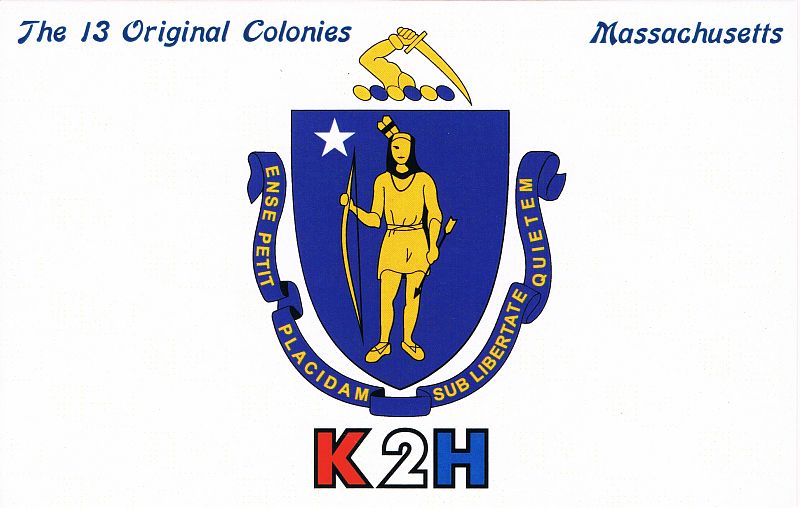
K2H 13 Colonies Special Event


While I was having coffee this morning and listening to 40 meters CW I heard this station calling "CQ CQ de K2H 13 COL" at a comfortable 18 wpm.  Usually short 1 x 1 call signs are assigned to special event stations.  I worked the station and then looked up the call on qrz.com and confirmed that the station was indeed part of a 4th of July Special Event celebrating the independence of the original 13 colonies.

I like making contact with special event stations and enjoy collecting these one of a kind QSL cards.  


Thursday, June 23, 2011

SKCC K3Y 2011 -- Special Event


These images are scans of two QSL cards I received this week confirming contacts I made participating in the SKCC's 5th anniversary special event.  Each January club members from the various U.S. call sign districts (see map below) can volunteer to operate under a special club call sign issued specifically for the month long event.  The object of the K3Y event is to work one unique station from each of the ten call sign districts.

Below are the back sides of the two cards listing the contacts I made and a brief history of the club.  I missed a full sweep of all call sign districts by one QSO.  Had I netted a contact with a California or Alaska K3Y station I could have received a certificate for my accomplishment.  I remember hearing a K3Y/6 calling from California and tried to reach him but evidently my signal was not reaching his antenna.  I'll look to nail it down next January and maybe consider even applying to operate as a special event station myself.

The design for the front of the QSL card is chosen by vote from examples submitted by club members.  This year's card featuring an old school drafting style drawing of the NT9K club key is my favorite and was the design I voted for.  My NT9K Pro Pump is the key I rendered in black and white and use as the header photo for many of my amateur radio posts. 


(Map attributed to Chris Ruvolo, Wikimedia Commons)


Saturday, March 12, 2011

QSL Card -- VE3CGC


My thoughts have been with the people of Japan.  Recent events brought to mind a QRP contact that I made last year using my MFJ 9040 5 watt CW transmitter.  Hiro was using a Icom 706 feeding 5 watts to a loop antenna.  Contacts between two operators who are both using QRP rigs and low power are extra special in my log book.  I've not yet worked a JA station with my meager antenna farm but I can say I have met a Japanese-Canadian ham on the air using my favorite mode Morse code. 

Best wishes and lots of hope for the people of Japan.


Wednesday, December 29, 2010

QSL Bureau


Yesterday I found a nice surprise waiting for me in the mailbox.  These QSL cards are the first ever batch of DX confirmations received at KD8JHJ via the QSL Bureau service.  The majority of these contacts I made during my first year as an amateur radio operator.

19/05/09   UR5ZEP          Ukraine                       14 MHz  CW
06/03/09   EB7ABJ          Spain                            14 MHz  PSK-31
01/11/09    EA7ACU         Spain                             7 MHz  PSK-31
21/11/09    PE0TS              The Netherlands     21 MHz  PSK-31
09/04/09   DL6KVP/p    Germany                    14 MHz  PSK-31
07/02/09   DD3FS            Germany                       7 MHz  PSK-31
24/10/09    DL8SDS         Germany                      21 MHz  CW
12/02/09    TG9AHM      Guatemala                    7 MHz  PSK-31
02/01/10    EA1EVA        Spain                            14 MHz  CW
23/01/10    HB9AAA       Switzerland                14 MHz  Feld Hell

QSL Bureaus are volunteer staffed organizations found in most countries that allow amateur radio.  The bureau system allows hams around the world to exchange QSL cards for a minimum postage cost.  The more avid the DX'er or card collector the more beneficial this system becomes.  

In 2009 after I began digital operations at KD8JHJ and had accumulated a dozen or so DX contacts in my log I filled out QSL cards for each foreign station I had worked.  I then sent the cards all together in one envelope to the out going bureau at ARRL headquarters in Newington, CT.  My cards were sorted by country and shipped in bulk with other QSL cards.  Once the bulk shipment is received by the Foreign bureau the cards are sorted again by callsign and delivered to the individual operators.

Here in America the incoming bureaus are divided up based on callsign areas.  Callsign areas are designated by the numeral that appears in all callsigns.  I had previously sent my QSL manager a half dozen stamped, self addressed envelopes to keep on file.  Once the bureau had received a dozen cards from foreign hams confirming contact with my station the QSLs were packaged up and mailed in one envelope.  Obviously saving me a bundle in postage.  The only caveat to using the bureau is the one to two year lead time as the cards work their way through the system.

The QSL Bureau is an ingeniously devised system and another unique facet of my favorite hobby- amateur radio.         


Friday, July 30, 2010

QSL Card


After seeing the e-qsl on my last post a reader asked about my qsl card.  Above is my most recent version qsl card.  The row of boxes at the bottom of the card are for filling in various information about the contact the card will confirm once sent to the other station "worked".  Callsign, date, UTC (24 hour time), frequency, RST (signal report) and Mode (SSB, CW, digital etc.).  The last box marked QSL will be checked "tnx" for thank you if you are replying to a card already received or "pse" for please if you are requesting confirmation.  
There are commercial printers who specialize in printing qsl's.  There are many options from generic plain templates to printers who make a qsl in full color from a submitted photograph.  When I first became a licensed radio amateur I didn't give qsl cards much thought, that is until I received my first one in the mail. I thought about it for a while and knew I had to somehow incorporate the Morse Code key into my card design since CW (radio-telegraphy) is my favorite operating mode.


I made a 200% scale pencil drawing of one of my keys, a Nye Speed-X straight key.  To the best of my knowledge Nye keys are still being produced in the Northwest, Priest River Idaho, to be exact. visit the Nye website here

Once I had a basic idea for my card sketched out I turned it over to a graphic artist to layout the text and bring it all together.  A special thanks must be given to Bob the artist.  Without his computer savvy design skills I would not have been able to create my own card.  We scanned the pencil drawing and imported it into the layout and sized it accordingly.  I took the file to Staples on a cd and had them laser print the cards on a vintage looking parchment card stock very much like the background of this blog.

I have enjoyed pencil drawing since I was a child however I don't do much drawing these days with so much other things going on.  I like to whip something out every once in a while just to prove to myself I still can.  I have maybe 8 or 10 hours in this drawing.  It is very tedious work with lots of measuring and obsessive fussing.  The gray image above the key is an actual post card size qsl laying on top of the original drawing.  

Qsl's are an old tradition and collecting them has become a fun part of the hobby for me.  I have not counted my collection in a while but I'm sure it's closing in on five hundred.  The most original and meaningful cards I have displayed on the wall above my operating desk.  This too has been done by some hams for the last hundred years.

Tuesday, July 27, 2010

New Benchmark at KD8JHJ


I did not realize it at the time but my recent PSK-31 contact with SV1BDO/3 in Egio, Greece is now my record longest distance two-way communication via amateur radio.  The distance between our antennas: 5,213 miles. Amazing!

The image above is an e-qsl (electronic qsl).  Traditionally amateur and commercial stations have issued QSL cards to verify contacts and reception reports.  Up until recent times QSL cards have always been printed on card stock like a postcard.  Exchanging paper QSL cards is still practiced among amateurs and some short wave broadcasters although the e-qsl digital confirmations are gaining acceptance due to many factors.  The always rising cost of postage and the long wait on international snail mail are probably the greatest.