Showing posts with label Insulators. Show all posts

Wednesday, September 10, 2014

Recumbent Ride - Heart of Ohio Trail


Last week a reader named Dave from Columbus mentioned that he had recently been riding on the Heart of Ohio Trail that runs from Centerburg, northeast to Mt. Vernon.  I know a trail that runs into Mt. Vernon but it's on the other side and it has a different name.  I've been riding the Kokosing Gap Trail for a few years and it is one of my favorites.  

Kokosing Gap Trail 2 1/2 miles east of Mt. Vernon
 I had no idea there was another rail trail in the Mt. Vernon area.  Thanks Dave!  As much as I love the Kokosing it's only 13 miles long end to end. I always start at Mt. Vernon and ride to the far end then back for a total of 26 miles.  While always a relaxing and scenic ride at 26 miles it's just a little more than a warm up when riding my recumbent bike so often I'm hesitant to make the hour long trip by car to get to the trail head.  

It seems that with every passing year I am growing less and less fond of sharing the roads with ever increasing car traffic and their inattentive drivers.  So in order to find solace and safety on the rail trail I'm willing to accept a bit of four-wheeled purgatory to get there.  Now with the discovery of a second trail radiating out from Mt. Vernon the thought of combining the two resulting in a 50 mile day makes the drive much more worth it. 

Yesterday I decided to give it go and motored to the small town of Danville that is the eastern terminus of the Kokosing Gap Trail.  From there I'd ride west to Mt. Vernon covering trail I'd been up and down many times for a warm up before going into adventure mode once I located the beginning of the HOOT trail.

I used the map on my smart phone to help navigate a couple miles of suburban streets across the southern end of Mt. Vernon and shortly I found the trail.  The map showed the trail starting right where I was but new looking trail pavement headed east back towards the center of Mt. Vernon so I decided I would explore that way on the return trip. 

As it shows in the opening picture I only had to pedal about a hundred feet and I was back in the shady peacefulness of the trees starting my first journey on the Heart of Ohio Trail.  I love exploring new trails where I've never been.  It's fun to see what's along the way.  After a mile or two the trees opened up and I saw this 1/4 mile drag strip. 


The HOOT trail follows a portion of the Cleveland, Mt. Vernon & Columbus Railroad and a few examples of its old iron is all that is left besides the grade itself. 


These bridges cross Dry Creek several times Although it didn't look particularly dry when I passed over.


This one had an active hornet's nest attached so I didn't hang around too long.


Before I got on down the trail I did notice this plant growing on the railing with its interesting spiny seedpods.  Not sure what it is.


The HOOT trail shot straight as an arrow for long stretches sharing the valley with State Route 36 and passed picturesque small farms and woodlands.


Another clue that a railroad once existed; glass telegraph insulators.  There was quite a few rotting poles along the trail but the pins were all bare except for this one which I'm sure is the one Dave mentioned in his comment.

 Eventually I pulled into Centerburg and the end of the paved trail.  Centerburg has its name because it actually is the geographic center of the state.  

On longer rides I carry a small snack to refuel at the half way point.  Some salty pretzels and a little can of Coke hit the spot.  One of the greatest things about cycling is how good food seems to taste both during and afterwords. I relaxed and finished my snack under the shade of a tree in a park before saddling up for the return trip.

When I was still a few miles out from Mt. Vernon while checking for traffic at a cross road I noticed this old brick building mostly obscured by trees.  I hadn't noticed it on the way out so I turned around and pedaled up to investigate.


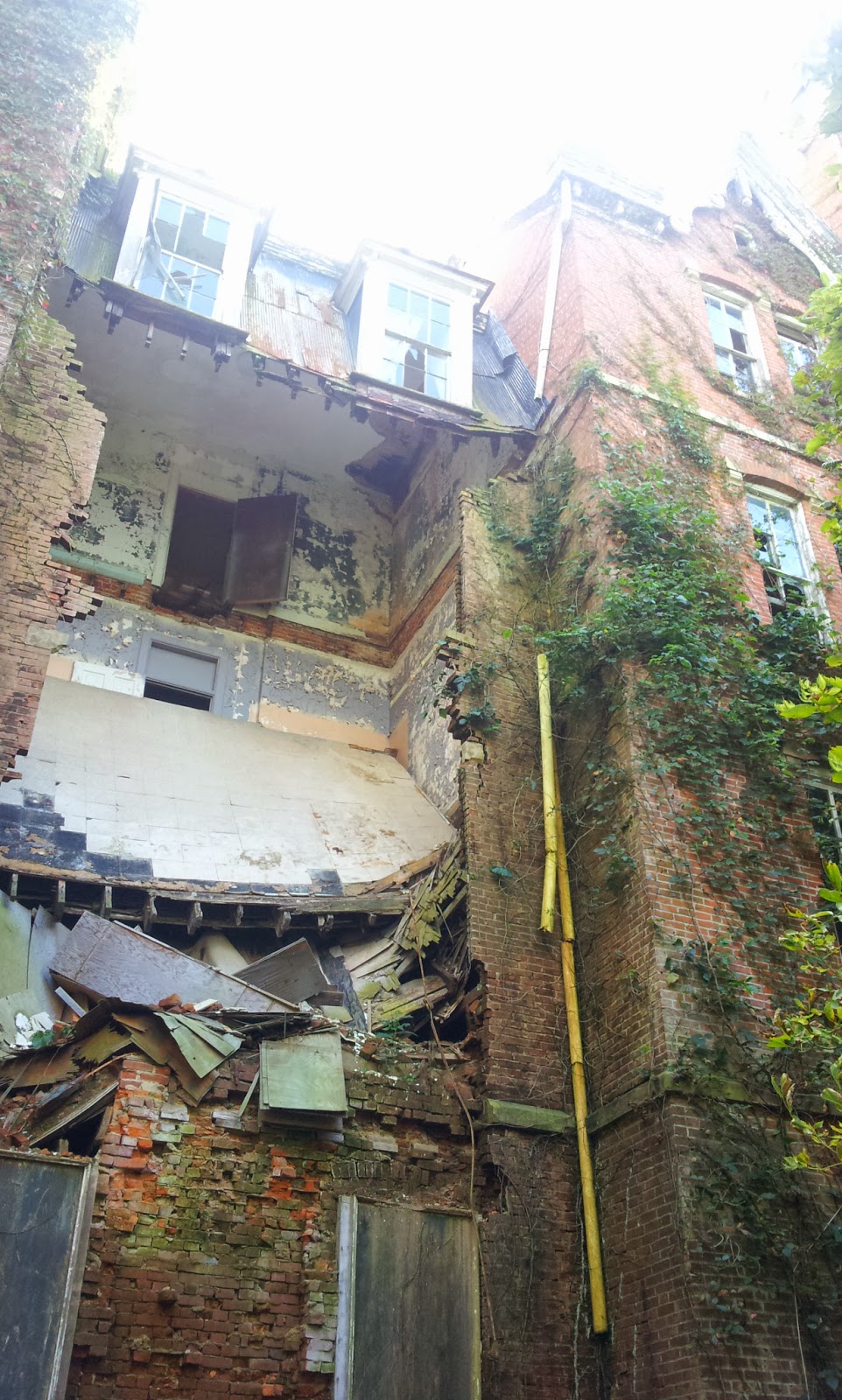
As I got closer I could see the structure was most definitely abandoned and in a sad state of disrepair.


I could tell it was an institution of some kind as I did a walk around of the grounds. Later I learned the place was known as the Knox County Poorhouse. First a residence for the county's less fortunate and later served as an infirmary and even a bible college before being abandoned for good.

Here is the best information I could find with a quick search:

In the 1912 "Past and Present of Knox County Ohio" Volume 1 on Page 80, the section on The Knox County Infirmary in part reads:  "from an early date (Knox County) had charity and compassion on its unfortunate poor. In 1842, the county commissioners bought 132 acres in southwest corner of Liberty township as its first poor farm. In 1874, it became necessary to provide better quarters for the poor of the county due to an increase in the number of poor. After several difficulties, the new building was completed in 1877. The institution is located on section 2, Liberty township, on a beautiful elevation of ground on the south side of Dry Creek, near Bangs Station along the line of the Cleveland, Mt. Vernon & Columbus railway. The original building is 75 by 127 feet, with an open court in the rear 34 by 55 feet. It is four stories high with a tower rising 65 feet above the roof. Over one million bricks were used in the construction. It has three water tanks on the upper floor holding 40 barrels of water each. The building was heated by steam throughout. There were 100 good rooms, accommodating easily 125 inmates. The tax-payers of Knox county have ever cared for her soldiers and other unfortunate citizens." 


Structural damage and decay is happening to several sections of the building.


At the rear of the house is this huge chimney which must have vented an incinerator or the steam boiler.  On the northwest corner of the structure I found a marble plaque with the date of construction and the county officials behind the project.


I'm glad I happened upon the place and was able to have a look around and take a few pictures. Like so much of Ohio's earlier architecture I think this place's existence is drawing to a close.

I rolled back towards Mt. Vernon and passed the point where I started on the HOOT and kept riding east.  This section of the trail was very new having been just recently paved.  I passed by an old industrial area where a large factory complex once stood. All that was left was a couple smaller building frames and this huge smokestack.


The trail eventually came to an end where it intersected an active train track running perpendicular to the old line.  Across the tracks I spotted the Mt. Vernon Station.  The trail section in my photo ends at State Route 13 just before the old iron bridge in the background.  Eventually the trail will continue on and link up with the Kokosing Gap Trail. 


Cyclists and other trail users in Knox County have a real prize in their midst with these two trails.

Kokosing Gap Trail - Heart of Ohio Trail
Bike:  HP Velotechnik Street Machine
Ride Time:  4:04:54
Distance:  55.69 Miles
Average Speed:  13.6 mph


Wednesday, August 13, 2014

Insulators In The Wild


Today I was out for a ride aboard my recumbent bike.  As I was cruising along the right of way of what was once a spur route of the Baltimore & Ohio railroad the glint of blue glass laying in this freshly worked field caught my eye.  I took a mental note of the location and continued on my with my ride.  I figured I would investigate on the way back.  Out in the middle of nowhere and only feet from the railroad bed the glass was most certainly a piece of an old insulator.


Sure enough on my way back I stopped and picked up the sky blue shard which was a piece of an old insulator.  In the photograph you can see a discoloration of the soil adjacent to the bike path.  This is caused by coal dust and cinders deposited by steam locomotives as they worked up and down the corridor long ago.  As I walked back toward the field edge where I had left my bike I forgot the shard in an instant as my gaze came to rest on an unmistakable shape resting in the dirt at the edge of the field.
  

Unfortunately when I pulled the object from the dirt I found that the insulator was cracked in half longitudinally.  In any case for me it was a stunning find.  Usually when insulators break they fracture in the middle along the wire groove creating a profile much harder to identify.


Clearly visible on the crown are the letters ATENT and below that 19 . 1871.

I wrapped the piece up carefully and stowed it in my pack and finished up my ride.  When I got home I thumbed through my insulator collector guide looking for the bullet shaped insulator.  Soon I located the familiar shape and positively identified my find as a CD 132.


The embossing on the crown of the insulator had it been complete would say Patent / Dec. 19. 1871.  This was a U.S. Patent issued to Robert Hemingray of Covington, Kentucky for a glass insulator molding technique he developed.  This insulator I found today is an example of one of Hemingray's earliest productions before the glass plant was moved from the banks of the Ohio to Muncie, Indiana in 1888.

While I would have been completely happy with my ride and the beautiful weather outside today finding this little jewel capped off my day perfectly.

Additional documentation at Hemingray.info


Tuesday, December 31, 2013

Insulator Post -- 2013 Springfield Finds


This year I almost skipped the big insulator show that happens every year in November at Springfield Ohio.  In the end I did decide to go after all.  The show is a bit of a tradition now with this being my fourth year of attendance in row.  As one of the biggest shows in the country I just can't pass up the opportunity of possibly adding some new pieces to my collection.

When I first got into collecting glass insulators I quickly took the sage advice of an experienced collector and specialized my interest in the hobby around the California Glass Insulator Company.  I love the soft pastel colors of the California glass and the interesting history of the company that operated for only four years. (1912-1916)  Now on the eve of 2014 I am certain that the pieces in my California collection are between 98 and 102 years old.  2014 is the 100th anniversary of the reorganization of the small upstart company which occured in 1914.


During a rare sunny day in December I set up in the back yard to photograph my new pieces.  In the above picture are four sage green CD 161 "Signal" Insulators.  These are a relatively common shape and color from CGIC and can be found for around $5 a piece or a bit more for a pristine example.  Note the difference in "Dome Glass" at the top of each insulator.  Dome glass is a term used by collectors to describe the solid glass at the very top of the insulator.  Because CGIC did not adhere to strict quality control measures back in the day the depth of the threaded hole and resultant dome glass can vary widely.


Even though I already have a few of these I couldn't pass up this nice pale purple CD 152.  A common insulator that once probably sat atop a pole along a railroad out west.


Two CD 102 Ponies and a CD 112 "Keg".  These little guys are a bit more rare. They were used on telephone circuits.

--

For the past couple years I've been looking for a scarce power insulator called a CD 208 "Cross Top"  Although commonly produced in larger numbers by eastern glass houses the California cross tops were made in limited quantities and used on only a few power distribution lines in the west.  These unique insulators got their nickname from the double grooves situated in a cross pattern at the top of the dome.  I'm not sure of the purpose of the double grooves but I suspect the arrangement offered more options to the lineman who secured the heavy power conductors to the insulator with tie wires.  Perhaps two tie wires would  be fixed at 90 degrees to one another providing a very secure attachment of the power line to the tower.


After carousing most of the show floor I settled on a beat up CD 208 that had some cracks, a broken inner skirt and severe wear on the top of the dome.  Normally I don't choose to buy an insulator unless it is very near if not mint condition.  This trade off in my collecting method means I have to be patient and wait for the right piece to come along or else settle for a less than perfect example of the CD I'm looking for.  In this case the desire to have a cross top in my collection won out over my normal modus operandi and besides the price was right on the damaged 208 at ten bucks.

After passing just a few more tables and nearly at the end of the show floor I spotted another cross top and to my amazement this one was in perfect shape.  Of course I had to pay full collector market price for this one but I finally found a winner cross top for my main window display.

Damaged insulator on the left.
Technical note:  For the opening group shot of insulators I used a setting on my Cannon camera called "Vivid".  This setting enhances the color which looks great but is not really a true representation of the colors as they appear.  The remaining pictures on the post were all taken with a normal automatic setting to account for the bright background.  I prefer to photograph glass insulators in direct full sunlight and while this does tend to wash out the look a bit I feel it provides the most accurate color representation of the glass.


Friday, October 11, 2013

Insulator Post -- Vintage Hemingray Recovered


One day last month I was riding along my local rail trail from the north end to the south end as is usually my practice. When on the return leg I noticed one of two old telegraph poles I pass along the way was not sticking up vertical anymore but laying in broken pieces on the ground.  The poles are noteworthy to me because they make up the last few that are still standing along the old B & O spur route that once connected Mansfield and Butler Ohio.


A few years ago I happened to be looking up (Something I'm often doing while reclined comfortably on my recumbent bike) and noticed that the two weathered poles still had some old aqua colored glass insulators on the cross arms.  I even took a picture of this particular pole with its cross arms tilting haphazardly.  The ever present tug of gravity and crumbling decay of the wood eventually brought the pole down and this is how I found it.  I noticed right away as I pulled off the trail and looked down at the broken pieces that there was not a single insulator in sight.

Oh well I thought the pieces were already picked and I just wasn't in the right place at the right time.  I was about to head on my way but I decided to get off my bike and take a closer look anyway.  In the grass half hidden under the pole a small patch of blue caught my eye.  I kicked away the debris and found an insulator still screwed onto a rusty pin.  In my excitement I scanned around the surrounding area and found the second one a few feet away just barely visible in the scrub.  At some point after the pole was already on the ground someone had cut down the taller brush in this little section between the road and the bike trail and I think that provided some of the cover for these two insulators to remain hidden until I came along.    


As an antique insulator collector this was a monumental piece of luck for me.  All of the insulators in my collection I have purchased from other collectors, found at garage sales and at insulator shows.  I have spotted many old insulators still stuck on poles some even with telegraph wire but this is the first time in my four or five years as a collector actually picking some pieces from a pole.

Long ago the copper wires these insulators supported carried land line Morse code telegraphy probably B & O railroad business, news and personal messages of citizens living in the area.  These two Hemingray - 42s were probably made in the 1920's or 30's.  They are not worth much maybe a quarter dollar a piece or fifty cents but knowing exactly where they came from and being able to document their provenance here for the future is something valuable to me.


Friday, December 14, 2012

Vintage Bicycle Art


I saw this antique metal sign at the Mid-Ohio Insulator Show last month.  The collector that offered this one up for sale explained that back in the landline telegraph era dispatch riders used bicycles to deliver telegrams.  100 years ago just like today bikes were a great way to get around town.
 
I would have loved to have this cool old sign to hang in my bicycle garage but as one of only four or five examples known to exist the seller was asking $600 for the sign.  I guess I'll just enjoy my digital photograph.


Thursday, November 8, 2012

Insulator Post -- 2012 Mid-Ohio Finds


Earlier this week I snapped a few photos of my new insulators from the 2012 Mid-Ohio show over my lunch hour to take advantage of the mid day sun.  In this first shot is a standard CD 161 signal of which I already have a couple of in this pretty sage color.  What caught my eye was a series of dimples or depressions in the glass along the bottom inside edge of the skirt.  While this anomaly doesn't add any value to the piece it is an interesting flaw that I've never seen in California glass before.
 
 
CD 152  I've got a few of these in light smokey purple but didn't have a green one so when I spotted this extra shiny sage example I had to have it.  Some insulators really display a super glossy wet-looking surface. These are my favorites.


Next we have a trio of CD 102 ponies (a nickname these little guys have had ever since the beginning of their use in the late 1800's). I like the ponies with their compact size and rounded domes.  The two smokey ones on each side have the original CGICo emboss while the aqua pony in the middle has the full CALIFORNIA emboss.  The middle insulator is likely a later production made after the company's restructuring in 1914.  Ponies were used for telegraph and open wire telephone circuits or "tolls"
 
I normally don't like to buy insulators with damage but California ponies in this pretty aqua blue color are relatively rare so in this case I made an exception.  It looks super in the photograph but around the back side there is a fingernail size chip out of the base and a crack running up the skirt about an inch.  The collector from whom I purchased the piece said I will probably have it for while before finding a flawless upgrade.  The damage is not visible from the front so I can live with it.  I think I paid $15 for the insulator.  A near perfect example would fetch between $75 -$100 on the collector market. 


Last but certainly not least is this awesome CD 178 "Santa Ana"  The Santa Ana is a high voltage distribution line insulator with some unique history behind it.
 
In an article in Crown Jewels Of The Wire CD178 collector Jim Sinsley speculates on the origins of these power pieces:
 
"it is interesting to note that the name was probably determined by the style's first use in a project for power distribution, about 1893, along the Santa Ana River Valley in Southern California to Redlands. They were designed to carry 5,000 volts, but were not abandoned when the line was upgraded to 10,000 volts in 1896.* I suspect, although there is no real proof that I know of, that the project was large enough that more than one manufacturer was used simultaneously to supply the first project. I believe that HEMINGRAY was among the first producers of the style and perhaps one or more of the Elmer companies also. I am confident that the style was popular enough and marketed for a long enough period of time that several companies got into the act. The original project in the river valley would have been completed before the California company was in existence. There have been a large number of CaliforniA and non-California pieces found in the San Joaquin Valley in California and others in the Mid-West. "


 Front emboss:  CALIFORNIA
Rear emboss:  303 over SANTA ANA
 
The Santa Ana is one of a few CD numbers not represented in my California collection so I was happy to have found this one and for a fair price.
--
 
Today the majority of antique glass insulators are "hunted" by attending shows or perusing sale lists online.  It wasn't always this way. The hobby can probably be attributed to linemen who in the course of changing out or dismantling lines would keep the pretty colored ones they found on the job.
 
The interest in the glass objects also germinated with boys over long summers as they scoured railroad lines as far as their legs and bicycles could take them in search of the glowing prize.  In the couple decades after the 1950's many abandoned lines still stood with the occasional glass dating from the early 1900's or even earlier just waiting to be picked.  Here's a great account of collecting in the early days of the hobby by Joe Maurath, Jr of Brockton, Mass: vintagestreetlights.com I could not link directly to Joe's notes on the subject of insulators but it's easy enough to access by clicking the link titled "insulator collecting" under the About Joe header to the left of the home page.  It's worth a read.


Sunday, November 4, 2012

42nd Mid-Ohio Insulator Show


On Saturday I attended the 42nd Mid-Ohio Insulator Show held as it is every year in Springfield, Ohio near Dayton.  Over the past four years this show has become the highlight of my insulator collecting hobby and I look forward more than ever to making the 100 mile pilgrimage.
 
The Mid-Ohio show is considered by many to be the greatest collection of insulators gathered together in one spot in all of the world.  I've only ever been to the Mid-Ohio show so I really can't say myself but to best this show it would have to be an event of ridiculous proportions.
 
I've covered previous trips to Springfield here on the blog but this year I tried to find some other interesting pieces that I've not documented before.  With that said let us get on with the tour! As soon as I entered the exhibition hall I saw these monstrous power line insulators.
    
 
For a sense of scale I laid my phone down on the table.  My Galaxy is not a small phone at all measuring 5 3/8" in length.  As with all insulator applications before the transition to porcelain in the 1950's glass was used for everything.  These big pieces were used on high voltage transmission line towers. 


Pictured here is nice aqua Hemingray "Muncie" These were made at Hemingray's second facility in Muncie, Indiana.


A person would need a lot of real estate if they were going to collect very many of these giants.


The best thing about attending these shows is seeing all the wonderful colors and shapes.  The unique champagne colored pieces below are called "carnival glass"  The color is the result of a surface treatment the glass underwent after the molding process.


Each year a topic is decided on for a community display.  A certain style or manufacturer of insulator is chosen and attendees submit their best examples of the chosen subject.  This is a great part of the show because it brings together a very large amount of insulators all sharing the same breed and illustrates the wide variation of colors that existed.  This year the style chosen was the common CD 145 or "Beehive"
 
Back in the early 1900's quality control was not like it is today. Whether by accident or intentionally pieces of debris such as chunks of metal and wire and fire brick from the furnaces would occasionally find its way into the molten glass.  Some collectors specialize in these "Junk In Glass" pieces.


When the glass insulator industry was young the techniques used were primitive and unrefined. As a result small bubbles and fizz often appeared in the solidified pressings.  Not so common were larger bubbles like these.


Besides the sales tables that fill the hall one wall is set aside for displays.  This was the best display put on this year. A very thorough and well set up display with examples of both glass and early porcelain baby signals.


Some collectors must have really deep pockets!  Check out the prices on these beautiful honey-amber Hemingray signals.  Very few were produced in this color and as a result the scarcity drives up the price.


If the ambers are too rich for your blood a nice cornflower blue could be had for a mere couple hundred.

I've been curating this web log for about three years now and in that time I have been content to just post up my ramblings in writing augmented with photographs I take of the things I do and places I see.  I've decided to get with the times and add a new tool to my box.  This year I witnessed something very cool at the show and while I was standing there I decided to take some video footage using my Canon digital camera.  Later I opened up a YouTube account and learned how to post up the media to it. Now for the first time in the history of Recumbent Conspiracy Theorist I'm pleased to present my very first video production:  Pressing Glass Insulator Miniatures


Commemorative miniatures have always been made at the shows but for some reason I had not seen the process in person.  I was so impressed I had to go back inside and purchase a couple of the pressings made earlier.  The idea of these minies as a souvenir to be sold off to show attendees is not a new one.  In the past small runs of miniatures would be produced as "salesman samples" to be given away to power and telecom companies when visited by the glass house salesmen eager to secure a lucrative contract to supply insulators to municipalities and utilities.
 
Another type of glass insulator that came after the telegraph era is known as the "Radio Strain"  These little strange looking pieces were used to isolate the ends of wire antennas supported high up in the air.  The support cord would be tied to one eyelet and and the antenna wire would be threaded through the other eye and doubled back on itself then secured with a few twists.  Strains were produced in many colors but most common are clear and lightly straw colored tints.


The same collector and insulator enthusiast who was producing the miniatures has also acquired an actual radio strain mold from the 20's or 30's and has begun pressing strains again using recycled cullet of all different colors.  Sometime I would like to pick up a few of these new ones or maybe even use vintage strains for my ham radio high frequency wire antennas. 


I had a great time at this years show and found a few nice California insulators for my collection.  Once we get a sunny day I'll take photographs and post up my new finds.  Here is a great CD 187 threaded spool made by the California Glass Works. Unfortunately I didn't have enough money so alas it did not come home with me.  The asking price was $115 -Ouch!