Saturday, July 21, 2012

Traditional Archery!


Today Wyatt and I took advantage of a beautiful sunny summer day to practice our archery skills.  Archery is an amazing sport that combines elements of extreme mental discipline, physical dexterity and strength.  There is something magical about watching the gentle arch of an arrow in flight and hearing the satisfying thunk of a well placed shot hitting home.

  I got serious about archery in the 1990's with the help of my brother-in-law who is an accomplished bow hunter and Native American expert.  I've shot bows and arrows all my life starting with the typical stick and string attempts while a boy.  As a older kid my dad got me a fiberglass recurve which I continued to use to advance my competency and simply have a lot of fun.  As an adult with an eye towards bow hunting I started off with a "wheel bow" or compound, the modern culmination of thousands of years of archery evolution.  

In time thanks in no small part to my love of history I soon discovered the incredible heritage that the bow and arrow has provided to mankind.  I jumped headlong into the world of traditional archery exploring the more organic experience of shooting a wood bow and arrow shafts and drifting away from the machine like and in my mind over commercialization of  the compound bow.  I learned to shoot recurves and longbows in the traditional manner through repetition. Aiming instinctively without the aid of a rack of sight pins much like a pitcher learns to throw a baseball into the box.

  I use a technique called "gap shooting".  When at full draw I orient the tip of the arrow to a position just below and to the right of my desired point of impact before I let it fly.  Over time and with lots of practice this automatic mental targeting system sharpens and even compensating the angle of the bow arm for elevation when shooting at unknown distances becomes second nature and not a conscious part of the mechanics of shooting. 


In the above photograph Wyatt captured the arrow in flight just an instant after release.  When an arrow is released the energy transferred from the limbs causes the shaft to flex and slightly bow around the handle as it leaves the string and begins it's trajectory.  This oscillation continues for a few cycles and the bend of the arrow is plainly visible in the shot. 
  

As much fun as I have with the hobby myself the real treat has been introducing this discipline to my son.  This summer he has grown strong enough to draw his mom's recurve bow which has greatly increased his range and precision.  The bow is a 25# recurve target bow and fits him perfect.


Range is about 20 yards.


Today was Wyatt's first time out with the recurve and he was enjoying himself immensely.  The performance was a huge step up from his basic "toy" kid's bow.  The arrows I handmade from Red Cedar shafts and natural feathers glued with the help of a fletching jig.

About ten years ago I reached the point where I had to try my hand at bow making.  After all I already had a woodworking shop and I always jump at the chance to use my skills from one hobby to augment another.  After much research I settled on a design and wood type to use.  The bow I'm shooting in this post is one I made in 2004 and is a Hickory backed Osage Orange flat bow.  The flat bow is a style of traditional long bow that was used by the woodland peoples who inhabited the Ohio valley for thousands of years.  Osage Orange, sometimes known as hedge-apple or boise d'arc from the Louisiana French literal translation "bow wood" is in my opinion the ultimate material for traditional bow making.  Besides possessing superior elasticity and the ability to remain flexible even in extreme cold temperatures this very dense and hard wood was first used for bows by Native Americans.  While my German ancestors from the distant past probably shot bows of European Yew I consider myself an American and I wanted to shoot the same wood as those who once roamed the forest and field of my homeland. 


This flatbow is 64 inches long and at my draw length of 26" the pull is about 47 pounds. I've chronographed the speed of a 525 grain arrow shot from the bow at an average of 180 feet per second.  Adequate energy to bring down any game in North America with a well placed shot.

This is the third bow I have ever made and the second from Osage.  I have been so happy with the performance of this one over the past eight years I've not felt the need to make another.  A curious trait of Osage Orange worth mentioning is the photo-sensitive nature of the species.  When first cut the color of the exposed wood is a bright lemon yellow.  As time passes the yellow mellows gradually to the  golden honey shades shown in the photos.  This slow color change adds a unique facet to the enjoyment of owning an Osage bow.

The hickory backing is glued to the front of the limbs to reinforce the wood fibers and prevent a catastrophic failure of the Osage limb.  Backing a bow was a technique also used by native Americans except instead of modern two-part epoxy and precision machined laminations the Indians used natural materials such as sinew and hide glue.


The arrow rest is covered with a small patch of Alaskan seal skin a durable yet slippery surface for the arrow shaft to touch before and during it's launch.  My arrows I also custom made from Sitka Spruce with a dark stain for camouflage, solid brass field points and banana cut barred feathers.

In closing I have to say this was a great father and son outing and something I have wanted to share in my blog pages for quite a while.  There is something special about archery that has been ingrained into the human psyche over the millennia.  The proof of this I think is watching the wonder and enthusiasm displayed by a youngster when given the opportunity to experience and develop one of mankind's oldest skills.


Sunday, July 15, 2012

Swartz Bridge Loop


I like to think of my bike as a time machine. Not in the literal sense but because I like to ride my bike to visit historic sites around Ohio it often feels as if it is transporting me back in time.  Saturday morning I chose a loop again towards the west to visit a very old and interesting structure.

Once past a small set of rolling hills things flatten out to the west.  There is not a lot to see out here mainly just agriculture -corn, soybeans, wheat and repeat.  Pedaling across these vast glacial plains it seems like I'm hardly moving as nothing goes by very fast except the road under my wheels.


A great feature of the recumbent seat besides the fact that it's a comfortable chair for all day riding is that the seat back is a good place to hang gear.  I have two seat back bags, a large and a small.  These bags are perfect for day tours.  They do not require a rack for mounting and easily carrying all the gear I may need.  The bag in the photograph above is the small size and it sees the most use on my bike.  Inside I keep two spare tubes, a 26" and a 20", a mini pump, tools, an extra bottle of energy drink and a bag of snacks.  In cooler weather there is still room for jacket, hats and gloves.

At the top of the bag is a grab handle where I attach my Road ID and a couple other things I might need in a hurry.  The square object is my camera case and I can easily reach back and grab it, shoot a photo and replace the camera all one handed while under way.  At the far right is a can of pepper spray for bad dogs who don't stay in their yards.

It took me  a couple hours to cross my county and into the next before my goal came into view.  The Swartz Covered Bridge was built in 1878 by Moses Weymouth and is located in eastern Wyandot County, Ohio.  The design is a Covered Howe Through Truss and spans 94.2 feet across the Sandusky River.


Although the design is considered obsolete the fact that the bridge is still standing 133 years after it's construction is testament to the craftsmanship and common sense design of times past.  I went down below to take a picture of the underside of the structure which is amazingly all built of wood.


In this photo the original sandstone foundation blocks can be seen.  On the opposite bank which is on the outside bow of the river the bridge abutment is reinforced with concrete to combat erosion.

I rested and had a snack in the shade of the north end of the bridge and snapped this picture looking east upriver.  I find it very interesting to sit and contemplate all the different people who may have come and gone across this bridge hidden away in the quiet countryside.  For the first few decades of it's existence the only traffic to cross the span was horse drawn carriages and wagons, pedestrians and maybe an occasional bicycle.


The ride home was uneventful.  The forecast called for a 50/50 chance of thunderstorms and while it did cloud up and look threatening a couple times it never did rain and the cloud cover provided welcome relief from a hot afternoon sun.


Railroad tracks in this flat country always provide an interesting point of view.


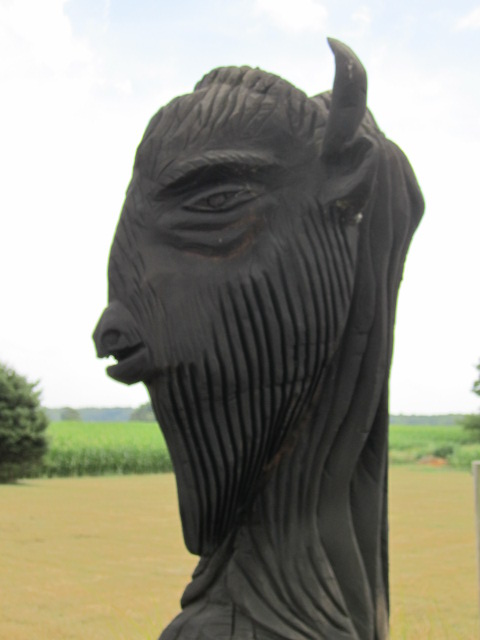
I passed this wood carving of a buffalo and couldn't continue on without a picture.  Little things like this is why I love bicycling so much.  Exploring out of the way places and finding unique stuff is a great way to spend an afternoon and one of my favorite activities.
--

Swartz Bridge Loop

Bike:  HP Velotechnik Street Machine
Distance:  50.16 miles
Ride Time:  3:40:36
Average Speed:  13.6 mph
Max Speed:  23.3 mph


Thursday, July 12, 2012

30 Mile Time Trial


I got a new battery for my cycle-computer and replaced the rear tube that suffered the blow-out the other day on my Motobecane road bike.  When I hit that stone on the bike trail it actually cut holes in the side walls of the tire so I replaced them with an older set of 700 X 25mm Bontragers I had laying around.  They might not be quite as fast as the 23mm tires I was using but they sure ride better.

As my work day progressed I formulated a plan to take off heading west from town on a road that runs relatively straight with few stops for about 17 miles.  I did intend to push for time and once I got underway I felt good and noticed the wind was coming from the south.  The perfect setup for an out and back route keeping the wind always at my side and removing the huge mental burden that a steady headwind presents.

The route takes me past an old one-room school house that has been pictured in these blog pages before.  As I neared the familiar structure I noticed something wasn't quite right.  As I got closer I saw with dismay that the recent wind storm had blown out the east wall of the school.  Without structural support the roof is starting to sag. 
   

A portion of the west wall was already missing and since the high winds blew in from the west I imagine the pressure build up was incredible inside the room and the old masonry just couldn't take it anymore.  The picture below shows the three tall window frames laid out perfect and some of the bricks are still oriented just as they were in the wall.  Sadly I think the history of this 100+ year old schoolhouse will soon be coming to a close.


I stopped just long enough to take a few pictures and then hammered on down the road.  I took the shot below on the 15 mile leg out.  At one point I nudged my average up to 17.8 mph but on the return my speed dropped to the lower 17's as the dull ache crept into my muscles.  After about mile 23 I was really starting to suffer but it's the good kind of hurt.  I kept my speed up and the miles ticked by which motivated me to keep the pressure on and I ended up rolling into the driveway much sooner than I had anticipated. 


I've mentioned it before in the blog that I believe putting in all those miles on the heavy recumbent really makes a difference when I get on the road bike.  I checked back through my records and the only time I was faster for a 30 mile all out effort was back in 2004 when I logged a time of 1:41:05 covering 30.4 miles at an average speed of 18.05 mph on my old Lemond aluminum frame.  Needless to say I'm stoked!  Even though I didn't set a new record I'm happy to be coming close to one I set eight years ago.
 
30 Mile Time Trial
Bike:  Motobecane Le Champion Team
Distance:  30 Miles
Ride Time:  1:43:45
Average Speed:  17.2 mph
Max Speed:  28.2 mph


Saturday, July 7, 2012

Clear Fork Loop 3


Recumbent Seat's View

With a couple days recovery from the Flat Fourth Fiasco I found myself back in the saddle or should I say recumbent seat.  I woke up early with the hopes of beating the heat and getting a nice road ride in the log but it was already 90 degrees when I left the driveway.  Even though it was sweltering I felt like hills so I pointed my cranks to the east and started off on one of my favorite local circuits -The Clear Fork Loop.

Since I've made this ride sort of an annual feature on the blog I chose today for this years installment. That's the reason for the "3" in the title.  After leaving the outskirts of  town I must cross a few miles of flat lands before the hills come into view.  This leg of the journey was uneventful until these two characters came out to the road to greet me.  I saw right away I couldn't outrun them so I stopped and made friends.  The big guy was laid back and friendly but little blackie had an attitude.  The little ones always do.     


Here's a rare self portrait of me at the base of Orweiler Hill.  Soon I would be cranking up that hill in first gear moving at a whopping 3 mph.  To climb on a recumbent requires a triple crank with a granny gear.  Contrary to what you might have heard climbing on a recumbent is very possible.  Smart gearing choices and in my opinion a hard shell seat to push against are the recipe for success.  I love climbing and have never had a problem on the bent.


il Tricolore

As I travelled along the route I watched the temperature indicator on my cycle-computer climb from 90 to 00.  It only has two digits in the readout so it was not able to read the full 100.  I saw it fluctuate as high as 07 and it sure felt like it.  One of the bicycle's great attributes is it's ability to keep it's rider cool as a side effect of locomotion.  No matter what the air temperature is if I keep moving I generally feel pretty good.  Stopping or slow climbs are another story altogether.

I noticed a little colorful symbol painted on the road as I climbed up out of the valley to the south.  It looked like an Italian flag and probably was as I was just around the corner from the famous Mid Ohio Sports Car Course.
   
  
A few revolutions further up the road I spotted this rusty horse shoe.  I'm not a superstitious guy but with my recent run of bad luck you can be sure I picked up this talisman.


As soon as I got home I tacked up the horseshoe above my workbench.  The open end goes at the top -to catch the good luck.  The shoe still had a few square nails so I straightened them out and reused them.


Clear Fork Loop
Distance:  28.16 miles
Ride Time:  2:20:00
Average Speed:  12.0 mph
Max Speed:  32.7 mph

More great photos from previous rides on this loop:
http://kd8jhj.blogspot.com/2011/05/clear-fork-loop.html


Thursday, July 5, 2012

4th of July Tale of Woe


With Independence Day falling on a Wednesday I found myself with a rare day off during the work week.  Of course the decision for a bike ride was a no-brainer.  I racked my Motobecane road bike and headed off to the trail head of the Richland County B & O Trail.  While I was unloading my bike I noticed the blank screen on my cycle-computer indicating the battery had given up the ghost.  This was slightly irritating but I like to think I'm not a slave to little electronic devices so I popped the unit off it's mount and left it in the car.  Besides maybe it would be fun for a change not to be constantly reminded of how slow I am.  My familiarity with the trail and posted mile markers really makes a computer far from a necessity. 


I struck off southward and enjoyed an almost vacant rail trail.  Evidently the oppressive heat, now edging into the 90's keeps most people home in air-conditioned comfort.  I like the heat and I have no trouble being out in it.  I seemed to make good time based on the high gears I was spinning and reached the bottom end of the trail where I hit up a convenience store for something cold to drink.  At this point I had 16 miles down and the return trip north would yield  a total of 32 miles. 

After a short break I sent a quick text to my wife and got back on the trail.  I settled back into a steady rhythm and was cruising along nicely until mile 22.  Suddenly and violently the back end of my bike bucked up and I heard the dreadful sound of 100 psi of air removing it's self from my tire.  The area through which I had been traveling was hemmed in by trees on both sides and the right-of-way was long ago cut long ago cut through a small series of hills exposing walls of crumbling shale on each side of the path.  These features create a dark, moist and deep forest like environment and along with the recent storms the trail surface was littered with debris.  Retracing my path I soon found the walnut-sized rock right in the middle of the lane among countless twigs and leaves.  Now that I had come to a halt and lost what little cooling effect biking through 95 degree air has the sweat began to pour.  In short order biting black flies had honed in my position and kept up with their own special kind of torment.

At this point I started to feel a bit uneasy.  I rarely flat on the bike.  The last time I got a flat tire was on the Lemond road bike about five years ago.  Luckily I was only a block away from home so I just walked it home and switched bikes.  I can't remember the time it happened before that.  Surely it was ten years ago or longer and I think it might have involved some nasty thorns picked up on a mountain bike trail. 

I returned to my bike to appraise the situation with the rear wheel.  I removed the inner tube and found two 1/8" long parallel slits one on each side of tube clearly indicative of a direct hit against the rock compressing the tire up and pinch flatting against the two rim walls.  The nature of the puncture had me worried to say the least.  In my seat bag I carry a patch kit and an inflator with a single CO2 cartridge which I know is the bare minimum but as I mentioned being a sprightly 155 pound rider I hardly ever flat.  A couple years ago I started to get into the habit of carrying a spare 700c tube along with the patch kit while on the road bike.  The problem is that my seat bag is only so big and just not enough room is left for the spare.  (I know, that's why jersey's have pockets.) Eventually I quit carrying the spare but I know right where it's sitting on my work bench.  I sent a text message to my wife and asked her to stand by her phone in case I needed more help.  To add insult to injury I noticed that my cell phone battery was critically low.  I sent another text indicating I was shutting the phone down to conserve what little power was left and would turn it back on later to let her know what was going on.

Working in the stifling humid air was no fun but I managed to get a rectangular patch wrapped two-thirds of the way around the narrow tube hopefully covering the two slits.  I gave the glue extra time to set up but it didn't seem like it was drying very well.  I reassembled the wheel and gave it quick shot of CO.  The tire expanded and held for a second and then with a psssst! the patch let go.  I still had some air in the cartridge but I had used all the glue in the tiny tube from the patch kit.  I stowed my gear and thought maybe I could try again with the remainder of the compressed air in the cart later after giving the glue some time to reset. 

I knew I was a mile or two from a point where the rail trail passes under a major interstate highway and by a nearby exit was a line of gas stations, restaurants and a hotel or two.  I tried my phone again but by this time the battery was shot and the phone had automatically shut off it's transmitter.  So cut off from the outside world I resolved to hike-a-bike it to the freeway exit where I could at least find a cool drink and a telephone.  Eventually I made it to a Speedway where a clerk was kind enough to let me borrow her cell phone.  I dialed my wife's number and waited, ring... ring... ring... she didn't pick up.  Annoyingly the voice mail system kicked in and I left a message describing where I was and that I needed her to come get me.  I waited around for a half hour unsure even if she had got my message.  Rather than walk back to the bike trail I decided to strike northward along the state route that shares the valley with the B & O Trail and would lead me to the next town a few miles away.  The state route is the way she would be coming so I figured she would see me along the way.  

I walked and walked and walked.  At some point the deflated tube and tire developed a squeak each time the reinforced bulge near the valve hit the lowest point in it's rotation.  Squeak... Squeak... Squeak it mocked me relentlessly as the miles slowly ticked by.  I hate walking.  By early evening I reached the Village of Lexington and past the local bike shop which of course was closed with it being a Federal Holiday.   By this point I had covered about five miles on foot and was about five miles from my car.  I had not spotted my wife's car in the last hour and had resigned to helping myself alone out of this jam so I got back on the bike trail and walked some more.

Dusk fell around me but the temperature did not. I plodded along into the twilight knowing I was closer to the car with each step.  The last few miles I started to notice white-tailed deer along a section of the trail where I know they are thickly populated.  The deer were a welcome diversion from the flies and the dull ache that had slowly crept into my legs.  One in particular instead of slipping into the underbrush along the trail as the deer usually do kept walking forward turning about every so often to peer back at though the gloom.  

Eventually no worse for wear I made it back to my car and returned home only three or four later than I had planned.  Although it may seem so I did not write this lengthy missive for the entertainment of you my readers but as a reminder to myself of how easily the whole misadventure could have been avoided.  Ironically in the large seat bag of my recumbent I have two spare tubes; one 20 inch for the small front wheel and a larger 26" for the back along with a mini-pump and a patch kit.  Never had a use for any of it in 2300 miles and of course I wasn't riding that bike.        
  
Old Mill at Butler, Ohio

So to make a long story short:  Pack the spare tube!


Wednesday, July 4, 2012

4th of July Pyrotechnics


I captured some great images with my Canon PowerShot at the city's 4th of July fireworks display.  Next time I'll try to remember a tripod.  The excessively long shutter speed catches the unsteadiness in my hand.  Still they are great pictures.  For best viewing click on any photo and look at them against the black background of the picture viewer.

Happy Independence Day!


Sunday, July 1, 2012

More Storm Damage


Today Wyatt and I took off on bikes and traveled to a park just a couple miles South of town to get some photographs of wind damage that I spotted from the car.  Seeing the desructive power of nature up close sure puts things into perspective.